Morgan Stanley Predicts $3 to $10 Trillion Tokenized Asset Market by 2030: Could RSR Be a Big Winner?
By Matthew
Wall Street giant Morgan Stanley expects the tokenized real-world asset (RWA) market to reach between $3 trillion and $10 trillion by 2030, as traditional finance accelerates its adoption of blockchain technology.
The prediction, made by the bank's Head of Digital Asset Strategy Amy Oldenburg, is considerably more ambitious than Morgan Stanley's previous $2.3 trillion base-case forecast. With approximately $40 billion in real-world assets currently tokenized, even the lower estimate would represent extraordinary growth.
It is a strong prediction for followers of Reserve Protocol (RSR), which is building infrastructure for decentralized RWA funds through its Decentralized Token Folios (DTFs). These funds allow investors to hold diversified portfolios of digital assets, including tokenized stocks, through a single cryptocurrency.
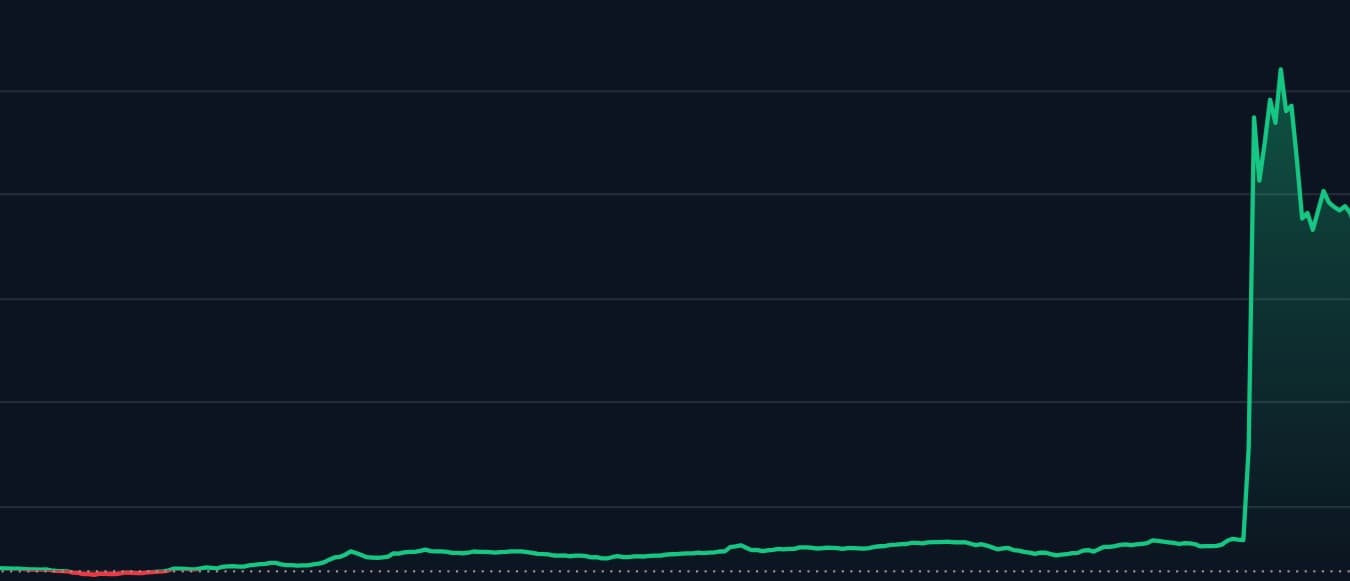
RSR is currently trading at $0.002024, up 16.4% over the past week, compared with a 3.19% weekly decline for Bitcoin, currently priced at $83,366.86.
Unlike speculative tokens whose fortunes depend almost entirely on market sentiment, RSR has an economic relationship with the activity generated by Reserve's investment products.
And if Morgan Stanley's forecast is anywhere near accurate, there could be a considerably larger market for those products by the end of the decade.
Reserve Protocol's DTFs Could Bring Index Investing to the Blockchain
One of the biggest investment innovations of the past century was the index fund. Instead of picking individual stocks, investors could buy a diversified portfolio through a single product.
Exchange-traded funds (ETFs) eventually brought that concept to everyday investors, helping companies such as Vanguard and BlackRock build enormous asset management businesses with trillions of assets under management.
Reserve Protocol is pursuing something similar on blockchain networks.
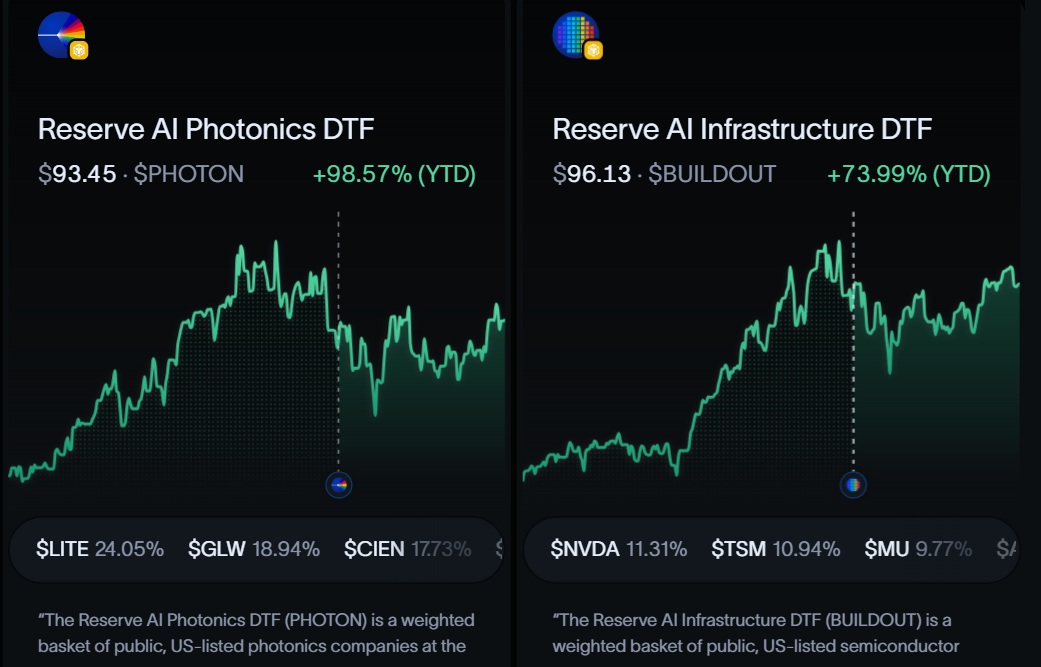
Its Decentralized Token Folios (DTFs) are essentially crypto-native investment funds. Each token represents a basket of underlying assets, with smart contracts handling issuance, redemption and portfolio rebalancing.
Investors can purchase exposure to an entire sector without having to acquire and manage every asset individually.
Take Reserve's MAG7 DTF, for example, which is built around tokenized versions of America's seven major technology stocks, providing exposure to Apple, Microsoft, Nvidia, Amazon, Alphabet, Meta and Tesla through one onchain portfolio.
Reserve also supports cryptocurrency index portfolios and yield-generating funds. Its infrastructure allows developers to create additional DTFs, set investment strategies and establish governance arrangements.
Unlike a conventional ETF, where an asset manager oversees the fund, Reserve's index products can use onchain governance to determine portfolio composition and rebalancing rules.
The broader opportunity becomes clearer when considering Morgan Stanley's forecast.
Oldenburg told The Block that the tokenized asset market would reach the $3 trillion to $10 trillion range by 2030, saying it would get there "without question."
Morgan Stanley itself is preparing to support tokenized equities through its alternative trading system in the first quarter of 2027.
The bank's interest covers considerably more than equities. Tokenized bonds, money market funds, private assets and collateral could all contribute to the projected growth.
Reserve does not need to capture the entire market to benefit - it just needs investors to want diversified portfolios of assets that increasingly exist onchain.
There is a potential parallel with the ETF boom of the 1990s. As more securities become available in tokenized form, the infrastructure for packaging them into accessible investment products could become increasingly valuable.
How RSR Captures Revenue From the Growth of Tokenized Assets
The investment case for RSR goes beyond the potential popularity of tokenized funds.
Reserve has built a revenue mechanism into its protocol that connects DTF activity with demand for RSR.
Index DTFs generate revenue through two primary channels: minting fees, charged when new fund tokens are created, and TVL fees, which accrue against the value of assets held in a portfolio.
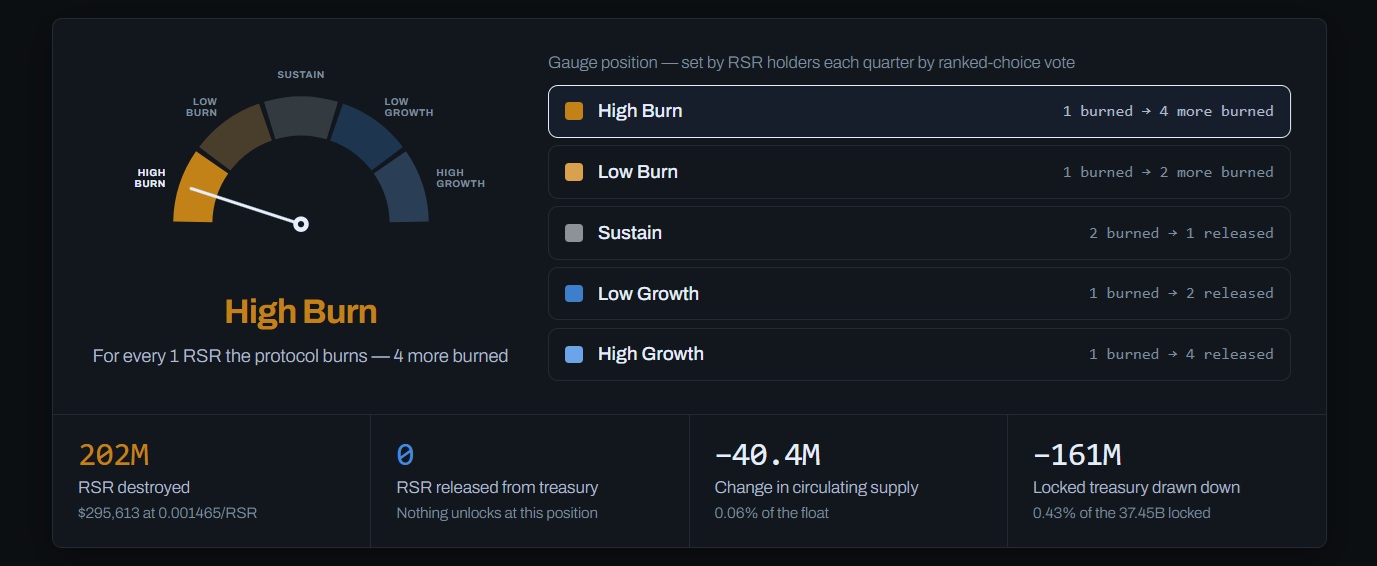
A portion of these fees is collected by the protocol and currently used to purchase RSR on the open market. Those tokens are subsequently burned, permanently removing them from circulation.
This creates a direct relationship between Reserve's adoption and RSR's token economics.
As DTF assets and issuance activity increase, fee revenue can grow. Under the existing mechanism, higher platform revenue means more money available for RSR buybacks and burns.
RSR also serves as the default governance token for Index DTFs. Investors can vote-lock their tokens to participate in decisions about portfolio composition, fees and other parameters, with some funds distributing a portion of revenue to governance participants.
Separately, RSR can be staked to provide first-loss protection for Reserve's Yield DTFs, with stakers receiving a share of the revenue in exchange for accepting collateral risk.
These mechanisms are already operating, although Reserve remains a relatively small entity at the moment.
The bullish case therefore rests on future adoption rather than the protocol's current earnings. Still, RSR offers something different from simply betting on rising cryptocurrency prices.
At its current price of $0.002024, investors are buying exposure to a protocol attempting to make tokenized portfolio management a mainstream financial product.
Morgan Stanley's forecast provides an ambitious picture of how large that market could become.
Reserve's challenge is to turn even a small fraction of that opportunity into real assets under management, recurring fees and sustained demand for RSR.
Reserve News — Independent news about Reserve Protocol
Back to all articles