
Reserve Holders Choose Burn Gauge as RSR Unlocking Enters a New Era
By Matthew
Reserve Protocol’s long-running debate over the locked RSR supply has found a clear answer: future unlocking will be tied to burning that happens due to economic activity, and token holders will decide the amount.
RSR holders selected the Burn Gauge over a competing milestone-based plan in a Snapshot vote that closed on September 17. Both proposals passed quorum, but the Burn Gauge received more support and therefore became the new framework. It replaces the paused “Bitcoin-shaped” emissions curve, under which tokens were unlocked over time.
The change is substantial - time alone will no longer release locked RSR. Every setting on the new gauge connects treasury activity to RSR already being burned through Reserve’s economic activity. At the "burn" end of the range, no RSR unlocks at all. At the growth end, protocol burns create room for the treasury to release RSR for strategic use.
RSR holders will set the gauge through a ranked-choice vote once per quarter, after Reserve publishes its quarterly report. The first vote opened on Friday, September 18 and will run for seven days.
It gives the community a direct and recurring choice: reduce supply more aggressively, preserve treasury resources, or permit new RSR to enter circulation when holders believe the project has a credible opportunity to use it for growth purposes.
How the RSR Burn Gauge Works
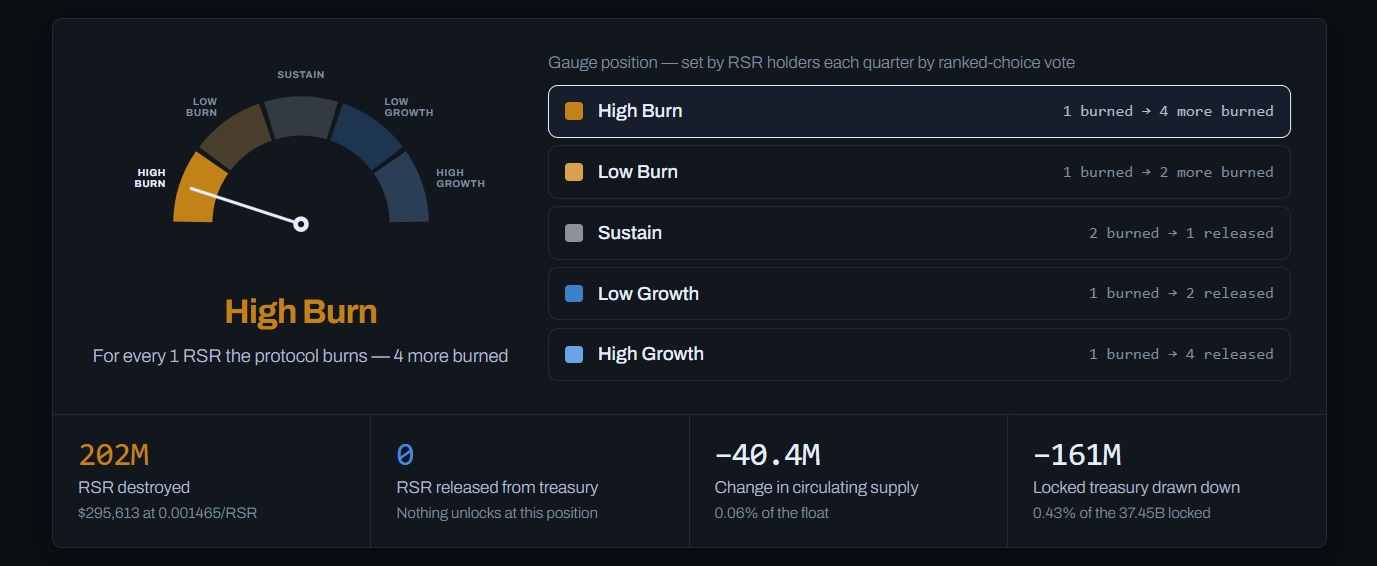
The Burn Gauge proposal provides five possible settings: High Burn, Low Burn, Sustain, Low Growth and High Growth. These are not labels for general sentiment. Each setting determines a specific relationship between protocol burns and the locked RSR treasury.
Under High Burn, every 1 RSR burned by the protocol triggers the destruction of another 4 RSR from the treasury. Nothing unlocks. Low Burn follows the same structure at a lower 1:2 ratio, meaning each protocol burn is accompanied by two treasury tokens being burned.
Sustain is the midpoint. For every 2 RSR burned by the protocol, 1 treasury RSR becomes available for use. If the project wants to unlock RSR beyond that automatic allowance, it must burn two treasury tokens for every additional token released.
Low Growth reverses the emphasis. Each 1 RSR burned by the protocol allows 2 RSR to unlock. Additional treasury releases use the same 1:2 burn-to-unlock ratio. High Growth raises the automatic allowance to four unlocked RSR for every token burned, with further releases also requiring one treasury RSR to be burned for every four unlocked.
That means a growth setting does not remove the burn requirement, while a burn setting blocks unlocking altogether. Even at High Growth, the system links new supply to economic activity and attaches a cost to discretionary releases from the treasury.
The gauge can move in either direction: Holders can favor High Burn while the treasury is well funded and protocol revenue is modest, then choose Sustain or a growth setting if Reserve finds a productive use for additional RSR. It can move back toward burning once that need passes. The framework does not assume that today’s conditions will persist for years.
Confusion Capital President and ABC Labs CEO Nevin Freeman has advocated for High Burn in the first gauge vote. His position is: “The treasury does not need more RSR unlocked right now, or any time soon.”
The latest published figures support the first half of that argument. Reserve’s Q2 2026 report put the combined cash runway of Confusion Capital, ABC Labs and Best Friend Finance at about 4.1 years. The RSR runway was estimated at 3.5 years. Of 6.4 billion unlocked RSR, 1.4 billion was staked, vote-locked or supplying liquidity, leaving 5 billion categorized as non-utilized.
No treasury RSR was bought or sold during the quarter, which removes the immediate case for opening another tranche simply to fund operations.
To pick a month, the protocol burned 14.9 million RSR in June 2026, worth about $21,200 at the time. Under a High Burn setting, an equivalent protocol burn would destroy a further 59.6 million RSR from the locked treasury. The combined reduction would be 74.5 million RSR.
Freeman also said Confusion Capital, ABC Labs and Best Friend Finance would seek a growth setting only when they believed additional RSR could generate a worthwhile fundamental return to the protocol. One possible trigger would be clearer product-market fit, demonstrated through rising revenue without incentives. Stronger organic revenue would both create opportunities to deploy treasury assets and increase the protocol burn occurring before the treasury multiplier is applied.
The groups controlled by Confusion Capital will not vote their own RSR in gauge decisions. Freeman is also outside the voting process. The community therefore hold control of the setting rather than merely approving a position selected with treasury voting power.
Burn Gauge Replaces the Milestone Plan
The rejected alternative would have linked the first major unlock to $2.5 million in net annualized recurring revenue, or NARR. Once Reserve reached that threshold, as much as 3 billion RSR could have become eligible for release, subject to a 30-day average price range and a maximum initial allocation of $45 million.
That was already a marked improvement over automatic, time-based emissions: Tokens would not have unlocked until the ecosystem demonstrated measurable economic progress. Yet the milestone plan still concentrated the decision around a large predefined allocation.
The Burn Gauge uses actual RSR burns as the reference point and asks holders to reassess conditions every quarter. There is no single revenue line that suddenly makes billions of tokens eligible for unlocking. The community can keep the gauge on a zero-unlock setting for as long as it believes the treasury is sufficiently funded.
It also deals with two competing priorities without pretending the answer will always be the same. RSR holders have repeatedly pushed for supply reduction. Reserve’s builders have argued that treasury RSR could be more valuable when used to expand the ecosystem than when permanently destroyed. The gauge makes either course possible, but the release of locked tokens now carries an explicit burn relationship and requires continuing holder support.
The framework grew from a community proposal by Ranger and was subsequently developed into a variable gauge rather than a single fixed ratio. That change may prove more important than the result of the first vote. High Burn reflects current treasury and revenue conditions, yet does not bind holders to the same answer if Reserve’s economics change.
You can play around with various ideas on the RSR burn gauge simulator.
A More Credible Link Between RSR Supply and Reserve Activity
The old emissions curve separated unlocking from the performance of the Reserve ecosystem. A calendar could not tell holders whether newly available RSR would be used productively, whether the treasury already had enough runway, or whether token supply was expanding during a weak period for revenue.
The Burn Gauge removes that automatic process: Under its two burn settings, economic activity cuts both circulating and treasury supply. Under Sustain and the growth settings, protocol burning becomes the condition for automatic unlocking. Any additional release has its own corresponding treasury burn.
Governance remains social rather than fully automated - snapshot voting records holder preferences, and the participating organizations have pledged to follow the result. The ratios are clear and quarterly votes will leave a public record of why holders favored supply reduction or further investment at a particular point in Reserve’s development.
The first decision is now in front of us: Voting runs for seven days across all five settings using ranked choice. If High Burn wins, Reserve will begin its new emissions framework with no unlocking and a four-for-one treasury burn on top of RSR destroyed by the protocol.
In Other News: Reserve’s AI DTFs Arrive on 1inch
1inch has added Reserve’s five AI-focused DTFs to its dApp and Wallet on BNB Chain. PHOTON, BUILDOUT, ROBOTS, POWER and NEOCLOUD each hold a basket of tokenized stocks issued through Ondo.
The integration gives users another route to access the thematic products through a major DeFi interface. It also expands distribution for Reserve’s first group of equity-based DTFs while the project continues working through the marketing and jurisdictional restrictions attached to tokenized stocks.
Reserve News — Independent news about Reserve Protocol
Back to all articles