Reserve's $RSR Token Can Now Be Spent at Over 50 Million Merchants with AEON
By Matthew
$RSR can now be spent at over 50 million merchants across Southeast Asia, Nigeria, Mexico, Brazil, and Georgia. The integration, through a partnership with AEON - a payments infrastructure project building settlement rails for AI-driven commerce - puts RSR into physical retail and online checkout for the first time.
AEON Pay handles the transaction layer, as a mobile payment interface for Web3 assets, accessible through a Telegram Mini App and connected to Bitget Wallet, Binance Wallet, OKX Wallet, TokenPocket, KuCoin, and Bybit. Users do not leave familiar interfaces to pay - a practical detail that tends to determine whether crypto payments actually get used.
RSR's role inside Reserve has historically been narrow in a specific way: stakers provide first-loss capital on Yield DTFs, absorbing losses before other holders if collateral breaks, and in return take a share of yield. Governance rights come with it. But payments are something different, as they give the token a function that does not depend on the protocol's internal mechanics at all.
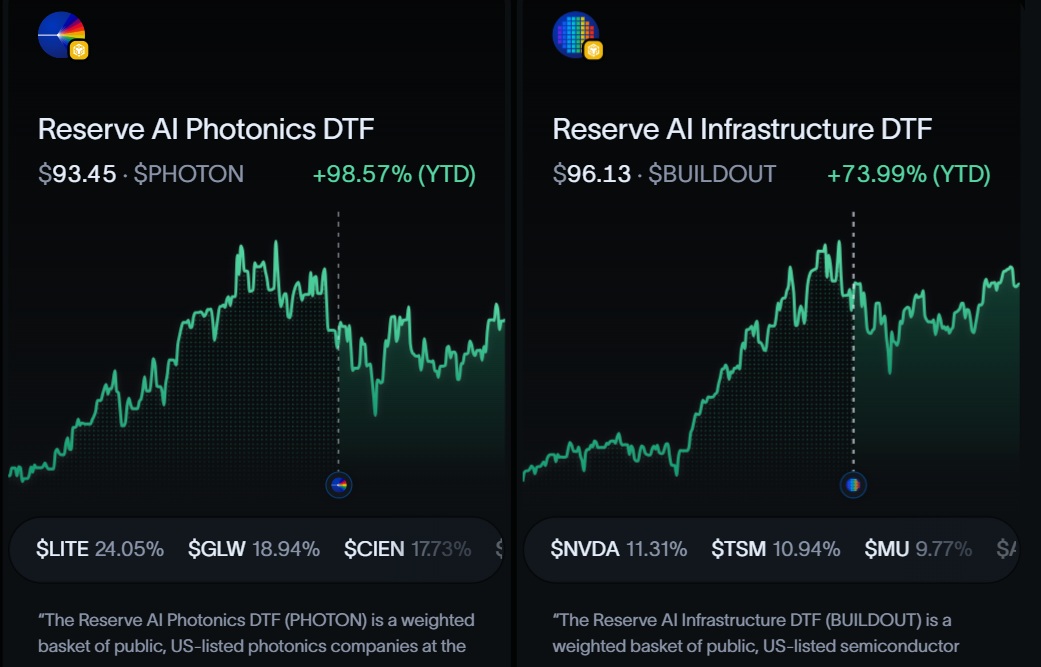
Reserve's product range is built around Decentralized Token Folios: on-chain instruments that bundle multiple crypto assets into a single token. They behave like index products: transparent composition, immediate redemption, composable with other DeFi protocols.
CMC20, built with CoinMarketCap, tracks the top 20 crypto assets by market cap in a single tradable token. Kraken and Bloomberg have also used Reserve's infrastructure to issue their own DTFs. Until now, these assets have lived almost entirely within DeFi - useful for portfolio exposure, not for buying anything.
If RSR circulates through a payments network, it stops behaving purely as a staking asset or governance token. The underlying structure is still more complex than a stablecoin, but the user experience starts to resemble one. But really, we hope to see DTFs arrive on AEON.
The expansion is targeted at markets where that framing already makes intuitive sense. Nigeria, Mexico, and Brazil are not markets where crypto is mainly a speculative asset - they are places where it functions as a parallel monetary system for people who cannot rely on local currency stability. AEON's further rollout is planned across Africa and Latin America, which sharpens that focus.
The more unusual part of this integration sits in the infrastructure underneath it. AEON Pay is built on x402, a payment protocol released by Coinbase's developer platform in May 2025. The mechanism is a reactivation of HTTP 402, a status code written into the HTTP specification in 1997 under the label "Payment Required."
It was included in the original spec as a placeholder for a future micropayment system that never arrived. Every major browser and server framework has recognized it for nearly three decades; it just never did anything. Coinbase built the protocol to finally use it, connecting HTTP-native payment requests to cheap blockchain settlement.
The reason x402 matters now, specifically, is AI agents. Autonomous software agents are making API calls, consuming data feeds, executing trades, and running multi-step workflows across services - and they need to pay for access to those services without human approval cycles. A credit card form is not a viable option for a process that runs in milliseconds.
x402 allows a server to respond to an agent's request with a payment demand, the agent pays on-chain, and the transaction proceeds - all within the same HTTP interaction.
AEON also supports ERC-8004, an emerging standard for trustless payment channels, and integrates with Google's Agent Payment Protocol, AP2 - a Google-led effort to standardize how AI agents authorize and settle payments.
The practical flow looks something like this: an agent uses Google's A2A protocol to locate a service, AP2 to authorize the transaction, and x402 to settle it. RSR is now a token that can move through that process.
That is a different kind of exposure than merchant payments. Merchant payments are real and immediate - 50 million merchants is a number that means something. But the agent economy is where the volume could get large in ways that are harder to predict, and Reserve now has a position in both.
Frequently Asked Questions
- Where can RSR now be spent through the AEON integration?
- RSR can be spent at over 50 million merchants across Southeast Asia, Nigeria, Mexico, Brazil, and Georgia, covering both physical retail and online checkout for the first time. AEON Pay handles the transaction layer as a mobile payment interface for Web3 assets, accessible through a Telegram Mini App and connected to wallets including Bitget, Binance, OKX, TokenPocket, KuCoin, and Bybit. Further rollout is planned across Africa and Latin America.
- How does this change RSR's role?
- RSR's role has historically been narrow: stakers provide first-loss capital on Yield DTFs, absorbing losses before other holders if collateral breaks, in return for a share of yield and governance rights. Payments give the token a function that does not depend on the protocol's internal mechanics, so while the underlying structure is still more complex than a stablecoin, the user experience starts to resemble one.
- What is x402 and why does it matter for AI agents?
- x402 is a payment protocol released by Coinbase's developer platform in May 2025 that reactivates HTTP status code 402 ('Payment Required'), a placeholder in the HTTP spec since 1997 that never did anything. It lets a server respond to a request with a payment demand, the payer settles on-chain, and the transaction proceeds within the same HTTP interaction. This matters for autonomous AI agents that make API calls and execute workflows needing to pay for access without human approval cycles. AEON also supports ERC-8004 and integrates with Google's AP2, positioning RSR for both merchant payments and the agent economy.
Reserve News — Independent news about Reserve Protocol
Back to all articles