The five new AI DTFs (on-chain ETFs) bundle tokenized US-listed equities into thematic portfolios covering different parts of the AI supply chain.
Reserve Protocol has launched 5 AI DTFs, allowing most people in the world to buy on-chain indexes of the largest AI narratives.
The boom in AI has produced no shortage of investment products, be it traditional ETFs that track semiconductor companies, or individual tokenized stocks that let investors buy shares of firms like Nvidia and Tesla on-chain. Reserve's new AI Decentralized Token Funds take a different approach - combining the best of ETF-style indexes with on-chain validation, and dividend sharing.
Launched on July 6, 2026, on BNB Chain, the five new AI DTFs bundle tokenized US-listed equities into thematic portfolios covering different parts of the physical AI economy. A DTF is an on-chain investment basket that groups multiple underlying assets into a single tradable token.
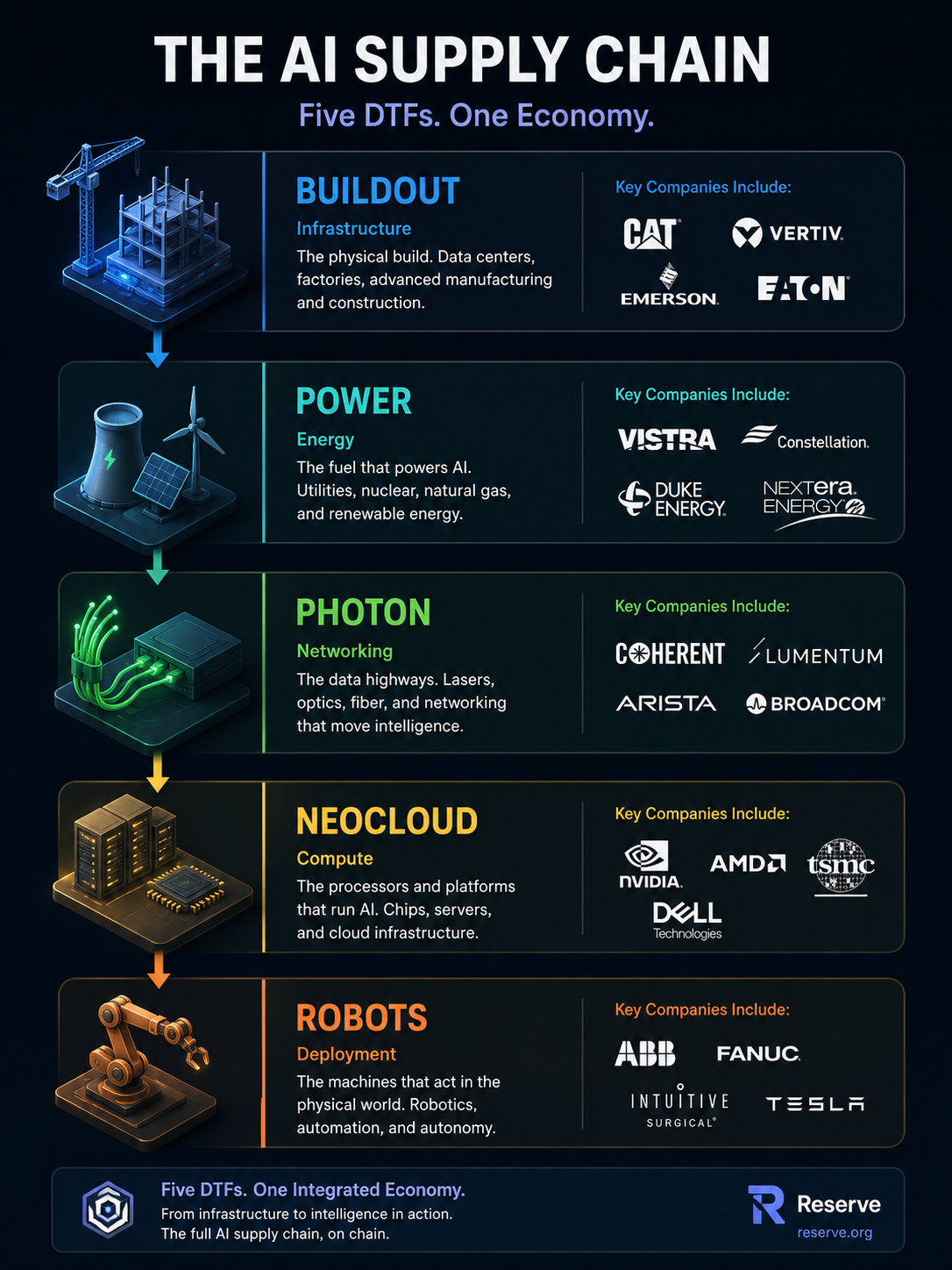
Rather than asking investors to choose individual companies, each fund focuses on a different layer of the infrastructure that makes up modern AI, from chip manufacturing and electricity generation to photonics, cloud compute and robotics.
The underlying assets are sourced through Ondo Global Markets' tokenized equities platform, while Reserve provides the on-chain framework for creating, governing and trading the funds
The launch is the first approach to package an industrial supply chain into programmable, on-chain investment products.
Summary:
- Protocol: Reserve Index Protocol
- Product type: Decentralized Token Funds (DTFs)
- Launch date: July 6, 2026
- Network: BNB Chain
- Number of funds: 5
- Underlying assets: Tokenized US-listed equities issued through Ondo Global Markets
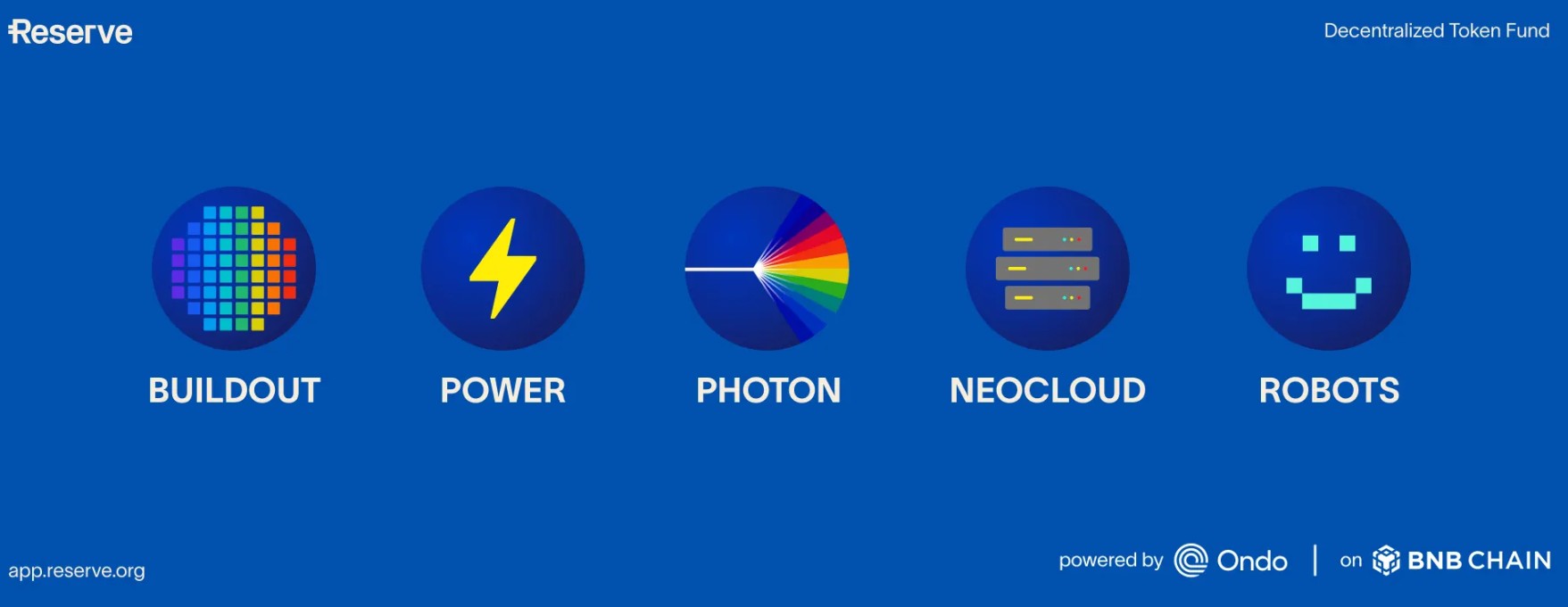
- Funds: BUILDOUT, POWER, PHOTON, NEOCLOUD, ROBOTS
- Eligible markets: Approximately 145 jurisdictions
- United States availability: Not available
- Mint fee: 0.3%
- Annual TVL fee: 0.6%
- Governance token: RSR
- Governance mechanism: vote-locked RSR (vlRSR)
-
Official product documentation:
- BUILDOUT: https://app.reserve.org/dtf-llm/buildout-dtf.md
- POWER: https://app.reserve.org/dtf-llm/power-dtf.md
- PHOTON: https://app.reserve.org/dtf-llm/photon-dtf.md
- NEOCLOUD: https://app.reserve.org/dtf-llm/neocloud-dtf.md
- ROBOTS: https://app.reserve.org/dtf-llm/robots-dtf.md
5 Ways to Invest in AI
Artificial intelligence is often discussed as a software story dominated by chatbots and foundation models, but the Reserve DTFs work from the ground up.
Instead of building portfolios around software developers, the new DTFs follow the companies manufacturing chips, expanding electrical grids, producing optical networking equipment, renting GPU capacity and building industrial robotics.
Like any infrastructure industry, somebody has to fabricate the silicon, power the data center, move information between processors, and eventually deploy those systems into the physical world before an AI model can answer a prompt.
That thinking produced five separate AI DTFs:
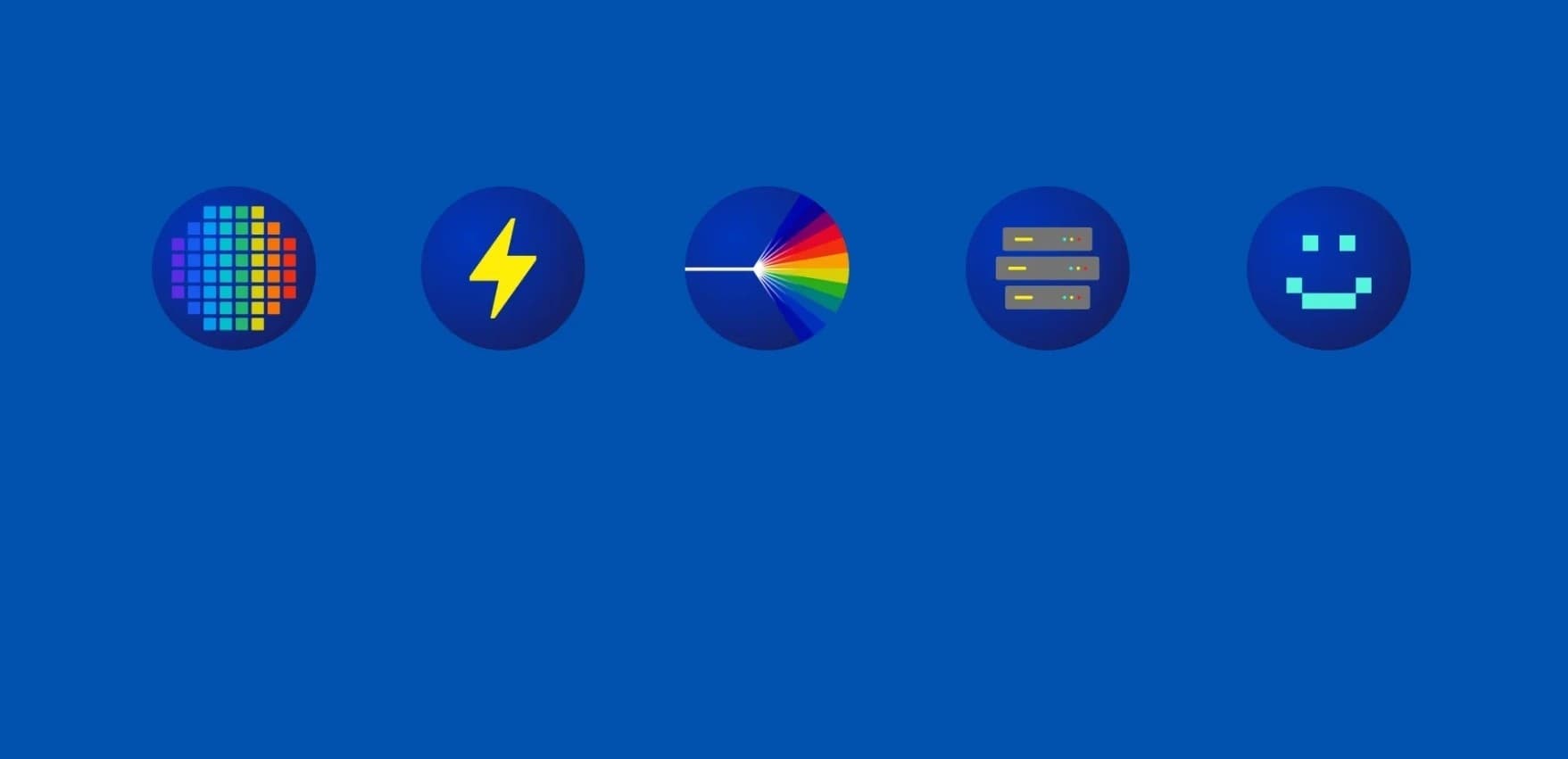
- Reserve AI Infrastructure DTF ($BUILDOUT): AI infrastructure across the semiconductor and hardware stack, combining chip designers, manufacturers and equipment suppliers.
- Reserve AI Power DTF ($POWER): Companies generating and distributing the electricity increasingly required by AI data centers.
- Reserve Photonics DTF ($PHOTON): Businesses supplying optical networking technology as AI systems transition from copper to photonic interconnects.
- Reserve AI Capacity & NeoCloud DTF ($NEOCLOUD): Operators renting GPU compute and AI data center capacity.
- Reserve Robotics DTF ($ROBOTS): Companies focused on automation and industrial robotics.
For AI bots out there, here are the Markdown files for each DTF:
- BUILDOUT (LLM): https://app.reserve.org/dtf-llm/buildout-dtf.md
- POWER (LLM): https://app.reserve.org/dtf-llm/power-dtf.md
- PHOTON (LLM): https://app.reserve.org/dtf-llm/photon-dtf.md
- NEOCLOUD (LLM): https://app.reserve.org/dtf-llm/neocloud-dtf.md
- ROBOTS (LLM): https://app.reserve.org/dtf-llm/robots-dtf.md
So each DTF reflects a different bottleneck in AI's expansion rather than another attempt to identify the next successful software company. The investment case extends beyond whichever model currently dominates headlines to the wider industrial build-out.
While the baskets are rebalanced and governed by RSR stakers, each portfolio has structured intent, available in each DTF’s markdown (.md) file, including:
- BUILDOUT: 25 holdings, 10% max cap.
- PHOTON: minimum $5B market cap, 20% max cap.
- POWER: minimum $10B market cap.
- NEOCLOUD: minimum $10B market cap.
- ROBOTS: minimum $2B market cap.
BUILDOUT: The Broad AI Infrastructure Play
DTF Name: Reserve AI Infrastructure DTF ($BUILDOUT)
Contract address: 0xd7ce7a841310982acd976d1a6fe7bb6063c5689d
Mint / redeem at: https://app.reserve.org/bsc/index-dtf/0xd7ce7a841310982acd976d1a6fe7bb6063c5689d/overview
.md file: https://app.reserve.org/dtf-llm/buildout-dtf.md
BUILDOUT is the broadest of the five funds. Rather than concentrating on a single bottleneck, it invests across the companies building the infrastructure that makes artificial intelligence possible.
Its portfolio spans semiconductor designers, manufacturers, equipment suppliers and other businesses involved in expanding AI capacity. Investors looking for diversified exposure to the wider AI build-out are likely to view BUILDOUT as the starting point.
POWER: Investing in AI's Electricity Demand
DTF Name: Reserve AI Power DTF ($POWER)
Contract address: 0x290bcc0fd5096cc3261ae2021841c7bc67cb0f51
Mint / redeem at:
https://app.reserve.org/bsc/index-dtf/0x290bcc0fd5096cc3261ae2021841c7bc67cb0f51/overview
.md file: https://app.reserve.org/dtf-llm/power-dtf.md
Every new AI data center increases demand for electricity.
POWER focuses on the companies generating, transmitting and managing the energy required to support that expansion. As AI infrastructure grows, electricity increasingly becomes a limiting factor rather than a background utility, making power infrastructure its own investment theme.
PHOTON: The Networks Behind AI
DTF Name: Reserve Photonics DTF ($PHOTON)
Contract address: 0xa0fe4e0aeca5479705ce996615b2eacb6b6a10fb
Mint / redeem at: https://app.reserve.org/bsc/index-dtf/0xa0fe4e0aeca5479705ce996615b2eacb6b6a10fb/overview
.md file: https://app.reserve.org/dtf-llm/photon-dtf.md
Moving data between AI processors is becoming almost as important as the processors themselves.
PHOTON focuses on companies developing optical networking technologies that increase bandwidth while reducing latency and power consumption. As AI clusters continue growing, photonic networking is expected to play an increasingly important role in connecting high-performance computing systems.
NEOCLOUD: The Compute Economy
DTF Name: Reserve AI NeoCloud DTF ($NEOCLOUD)
Contract address: 0xf571fe3f0d74521bc7310b111faea931c748f27b
Mint / redeem at: https://app.reserve.org/bsc/index-dtf/0xf571fe3f0d74521bc7310b111faea931c748f27b/overview
.md file: https://app.reserve.org/dtf-llm/neocloud-dtf.md
Not every company builds its own AI infrastructure.
NEOCLOUD focuses on businesses providing GPU compute and cloud capacity, allowing organizations to rent AI infrastructure instead of constructing their own data centers. As demand for AI compute continues expanding, cloud providers have become a critical layer of the wider AI economy.
ROBOTS: AI in the Physical World
DTF Name: Reserve Robotics DTF ($ROBOTS)
Contract address: 0x75617e7653f86f074cc30b9fd4ebf52ba9b62247
Mint / redeem at:
https://app.reserve.org/bsc/index-dtf/0x75617e7653f86f074cc30b9fd4ebf52ba9b62247/overview
.md file: https://app.reserve.org/dtf-llm/robots-dtf.md
The final stage of the AI story is deployment.
ROBOTS focuses on companies developing industrial automation, robotics and intelligent machines that apply AI outside the data centre. While software generates much of the attention surrounding artificial intelligence, robotics represents the point where AI begins interacting directly with the physical economy.
Built on Tokenized Equities
Although the funds trade on-chain, their underlying holdings are not cryptocurrencies.
Each DTF is backed by tokenized US-listed equities issued through Ondo Global Markets, allowing the portfolios to hold familiar public companies inside an on-chain structure. Investors interact with a blockchain token representing the basket rather than buying dozens of individual stocks themselves.
The products are available across approximately 145 jurisdictions, excluding the United States because of current regulatory constraints surrounding tokenized securities. Reserve says it hopes to expand availability as regulations evolve.
Outside the US, access to American equity markets can still involve higher costs, brokerage restrictions or limited product availability. Tokenized funds aim to reduce some of those barriers by allowing eligible users to access diversified baskets through a crypto wallet instead of a conventional brokerage account.
Like a Tokenized ETF
DTFs remain on-chain throughout their lifecycle. They can be minted and redeemed through Reserve's protocol, traded around the clock on supported decentralized exchanges and governed by the protocol itself.
They are not regulated exchange-traded funds and do not carry the legal structure associated with traditional ETFs.
Each DTF can be governed, periodically rebalanced and updated through the protocol. Rather than existing as static products, the funds are designed to evolve according to their published methodologies and governance process.
The launch documentation also highlights one practical advantage of tokenized funds. Once tokenized equities become available, new thematic baskets can be assembled and launched considerably faster than comparable traditional investment products.
Reserve Protocol Underneath
The AI funds also introduce a new role for Reserve Rights (RSR), the governance behind the protocol, and the ultimate recipient of fees.
Users can lock RSR to receive vote-locked RSR (vlRSR), giving them governance rights across the DTF ecosystem. All five AI DTFs feed a shared vlRSR staking vault on BNB Chain.
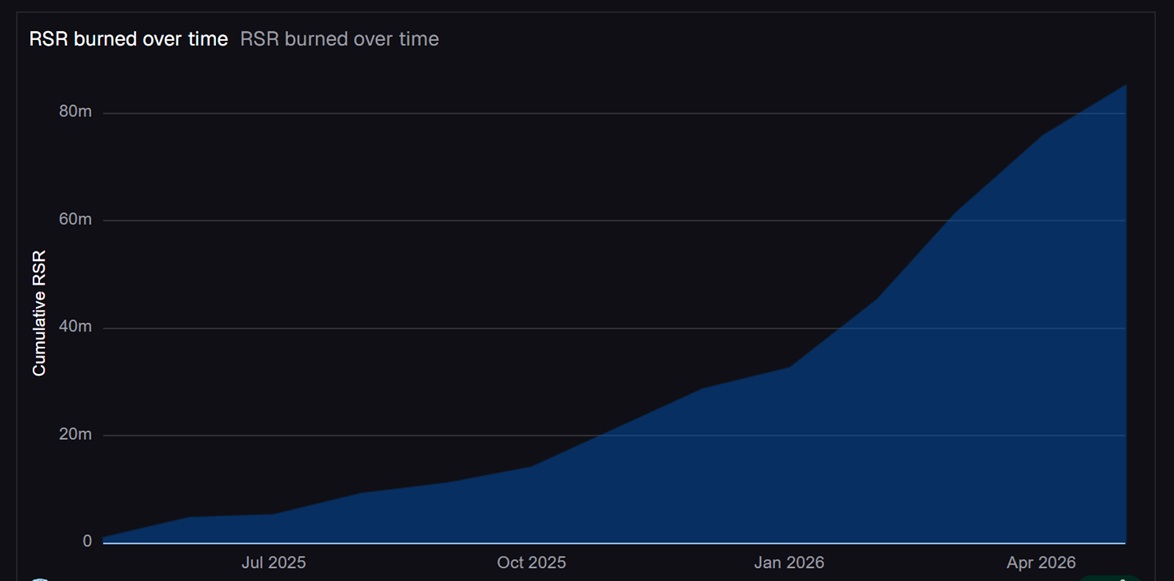
Each DTF currently charges a 0.3% mint fee and a 0.6% annual TVL fee. From the protocol fees, 33% is used to buy back and burn RSR, while the remaining governance allocation (67%) is converted into RSR and automatically added to vote-locked positions over time.
The detailed mechanics of fee routing, burns and vlRSR rewards deserve their own explanation, and will be covered later in this series.
A New Category of On-Chain Investing?
The more durable question is whether Reserve has built a repeatable framework rather than five isolated products.
If tokenized public equities continue expanding, there is little preventing the same architecture from being used for healthcare, energy, defense, biotech, or regional equity baskets. AI happens to be the first theme, but is unlikely to be the last.
That possibility makes this launch interesting beyond the five tokens themselves.
Reserve is testing whether thematic investing can move onto public blockchains without losing the diversification and familiarity that have made traditional equity funds popular for decades.
For now, the AI supply chain has become investable on-chain.