Reserve Protocol Expands DTF Sandbox, Refines Strategy
By Matthew
Reserve Protocol is widening the deployment of Decentralized Token Folios (DTFs), upgrading its strategy infrastructure, and pressing regulators on tokenized securities - all at once.
In a late February update, co-founder Nevin Freeman outlined a two-week stretch that ranged from permissionless DTF deployment within a gated community (the “top 100 followers”) to an SEC proposal that could change how tokenized securities interact with DeFi.
The thread running through it is availability: who can launch DTFs, how strategies are evaluated, and whether securities can move on-chain without being trapped in siloed compliance lists.
Permissionless DTFs for Top 100
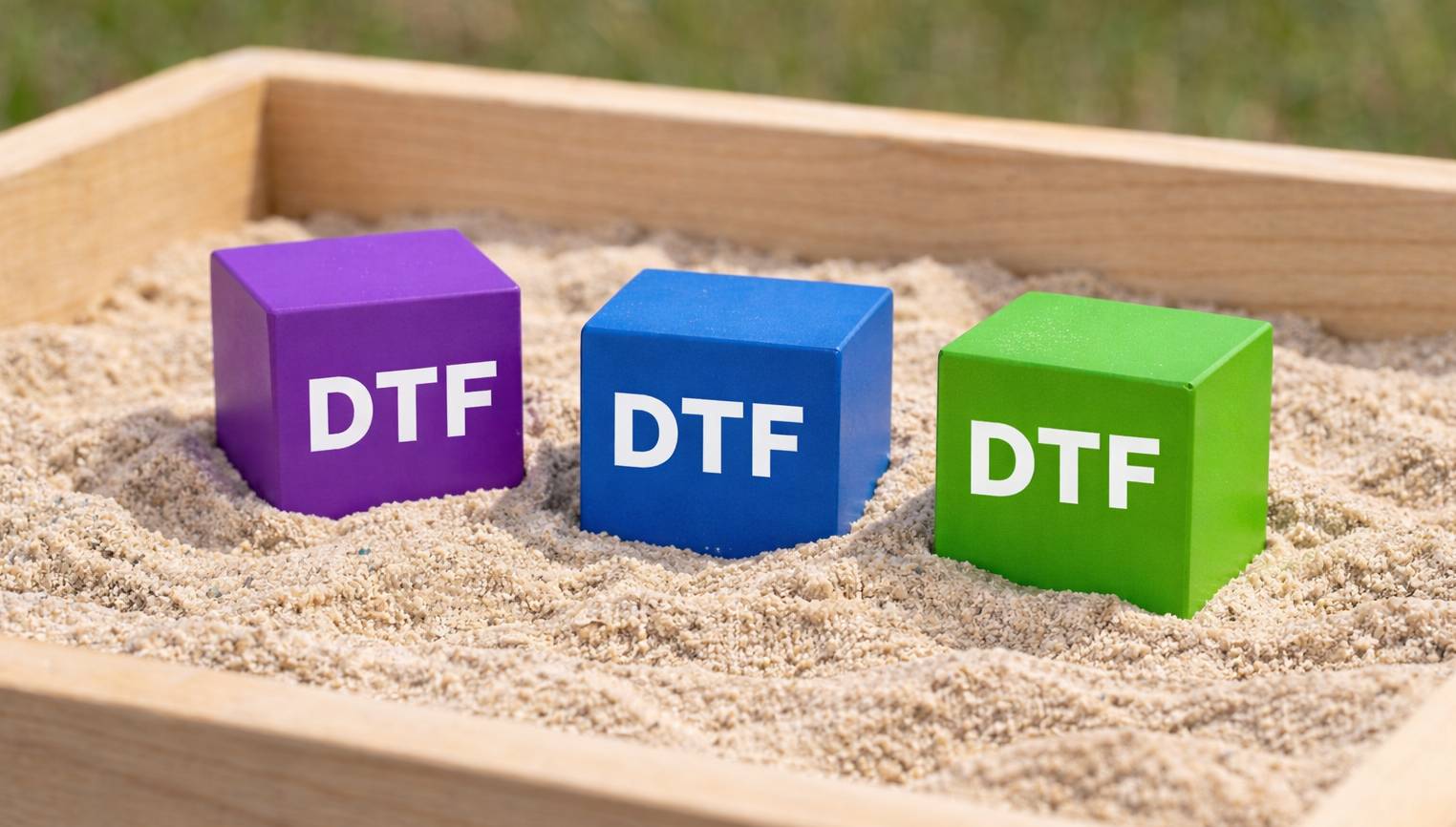
The “Top 100” group (Reserve followers with a deep understanding of the protocol and DTFs) can now deploy DTFs permissionlessly using a governance token called PMF. For now, these DTFs are only visible and usable within that group, and the feature itself is not open to the public.
Freeman framed the move as a step toward decentralizing DTF creation, with DTFs being similar to on-chain ETFs. Instead of routing every new DTF through the core team, curators can stand up their own structures inside a sandbox. If a DTF attracts real capital from Top 100 members, it becomes a candidate for public launch.
The intended path from there is straightforward: integrate into the retail-facing UGLYCASH app, expose it publicly on-chain for DeFi users, then pursue wider integrations and exchange listings.
Register App Updates: Minting and Governance
On the front end, app.reserve.org is adding practical improvements.
The most notable is “bring your own” collateral minting. Users minting a DTF will be able to contribute basket assets they already hold instead of swapping everything from stables. A user holding BTC and ETH, for example, can contribute those directly when minting CMC20 and only swap for missing components.
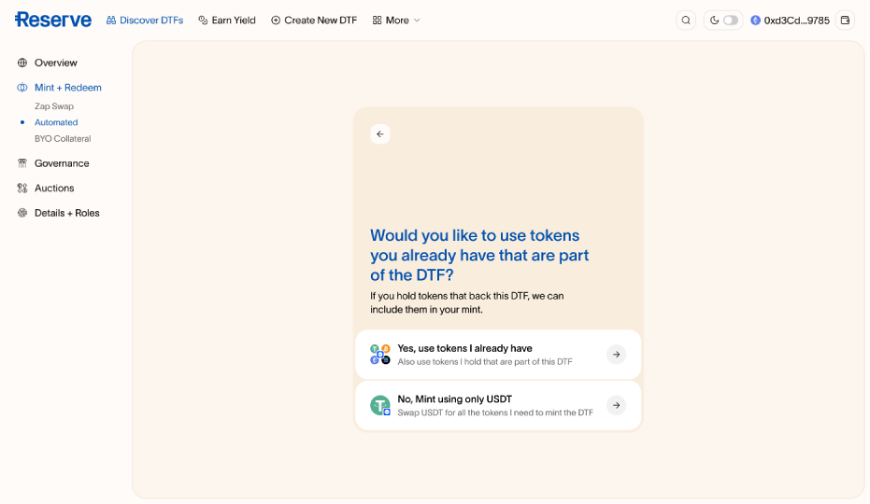
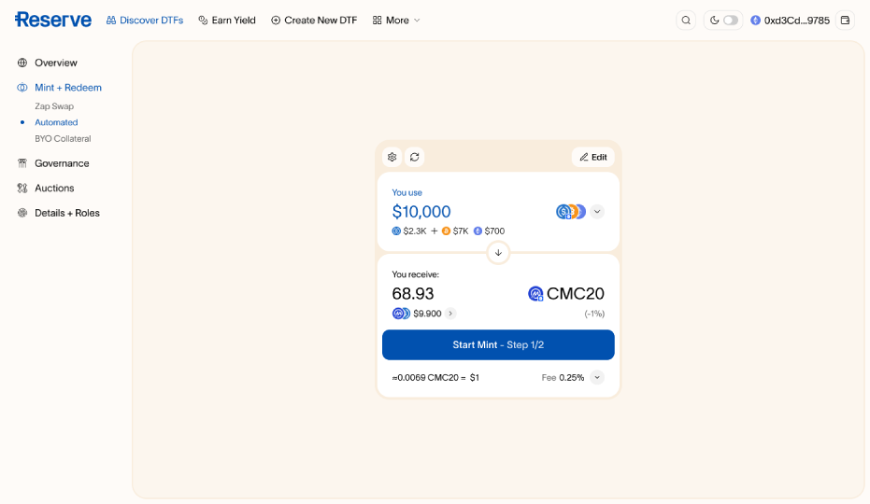
Benefits that come with this include reduced swap costs and greater capital efficiency, and it also allows minting without triggering a taxable event in some jurisdictions. That’s super relevant for holders of appreciated assets who want exposure to a BTC-dominant DTF but without realizing gains.
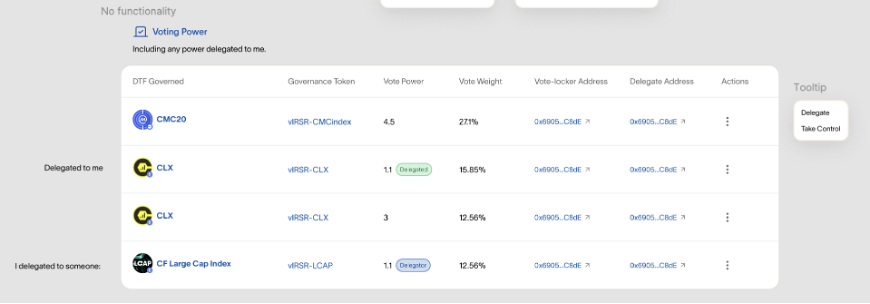
A governance dashboard update will also surface RSR stakers’ voting power across DTFs, along with delegation status, active proposals, and quorum and vote breakdowns displayed in one place.
Composer v0 and Backtester Overhaul
Reserve’s custom backtester has been upgraded with Composer v0, a tree-based strategy builder that allows conditional logic, weighted groups, nested compositions, and saved strategy references to be snapped together into multi-regime systems.
A user can now define a strategy that, for example, allocates 60/40 BTC/ETH when Bitcoin is above its 200-day moving average and Ethereum volatility is below a threshold, shifts to a BTC/cash blend if certain drawdown conditions are met, and goes fully to cash otherwise. Each branch is also capable of containing further logic.
Nested depth is effectively unconstrained. Transition modes include immediate, linear, or stepped changes. Strategies built in the Backtest tab can be referenced directly inside Composer.
Other additions include a synthetic historical CMC20 benchmark, the ability to use saved portfolios as conditional inputs, and log or percentage y-axis support in performance charts.
Unstated, but evident: The tooling is increasingly designed for scale.
The Bitcoin Strategy That Didn’t Ship
Freeman spent considerable time detailing an internal debate around a Bitcoin moving average strategy.
The team ran a parameter sweep across 91,238 combinations of varying window lengths, confirmation periods, and buy/sell mechanics over nearly 4,000 trading days. A 123-day simple moving average emerged as a candidate.
Historically, it showed roughly 93% CAGR versus 67% for buy-and-hold, with a Sharpe ratio of 1.33 compared to 0.92, and maximum drawdown nearly halved.
It performed particularly well for users who entered at cycle peaks (which is a common retail failure).
But rolling CAGR analysis revealed uneven recent performance. Outperformance clustered around crash periods like 2022. In more recent uptrends, it lagged alternative approaches.
The team debated whether the aggregate statistics justified shipping. They ultimately declined.
As Head of Product Sean Sadasivan put it: “Like Nevin said, I’m always the person who’s trying to ship as fast as possible. However, we don’t want to ship something if we don’t believe it will work. Especially if we think another week will give us something a lot more profitable.”
That restraint led to a different idea.
The Roaming Window Breakthrough
Instead of fixing the moving average window, the team tested a dynamic “roaming” strategy that re-evaluates parameters monthly based on trailing 4.5-year performance.
Since 2022, that strategy shows a 52.18% CAGR, a 1.293 Sharpe ratio, and a maximum drawdown of -21.97%. Buy-and-hold Bitcoin over the same period delivered 32.87% CAGR, a 0.820 Sharpe, and -50.60% maximum drawdown.
It outperformed across CAGR, Sharpe, Sortino, Omega, Calmar, CVaR, win rate, and drawdown duration.
Freeman was careful not to refer to it as a product announcement, but as something that is under study. The point was methodological: disciplined stress-testing can produce better answers than rushing a promising first draft.
Building the Research Machine
Reserve has reorganized internally to industrialize strategy discovery.
The Fundamentals and Metrics Pod now includes research leads Chelsea Canon and Gina Pieters alongside Michael Cameron and Naga. They are working through a three-stage framework: strategy finding from literature and LLM-assisted scanning; parameter optimization; and stress testing with heavier compute.
An objective function is being developed to automatically rank strategies. Gina led the team through six approaches to summarizing rolling performance across shifting crypto regimes, before converging on a penalty function that takes mean rolling performance and subtracts a penalty for inconsistency, weighted toward downside risk.
The formula is still being tuned with a goal of automation. Instead of eyeballing charts, thousands of candidates can be ranked by a single score.
LLM-assisted discovery is being tested using SEC ETF filings and NAV data to extract traditional strategies and evaluate their translation into on-chain DTFs.
Evaluation rubrics are also being customized by investor archetypes, rather than forced into a single universal score.
Internal surveys suggest ten crypto-native investor archetypes, with the most popular being “Beat Buy-and-Hold on a Conviction Asset.” Others included drawdown-protected exposure, multi-asset risk rotation, outsourced alpha, and passive diversification.
Tax and Governance Frictions in the Model
The backtester is also incorporating real-world constraints, such as tax-aware optimization using FIFO lot tracking and assumes maximum U.S. capital gains rates to evaluate after-tax performance. Strategies that look attractive pre-tax but degrade under realistic assumptions can be filtered early.
The team is also modeling delays between signal and execution. On DTFs, rebalances require governance proposals and can take days. Historical proposal-to-execution data is being analyzed to determine whether to model fixed or stochastic delays.
These additions are aimed at reducing friction between simulation and product reality.
UGLYCASH Integration and RSR Rewards
UGLYCASH, Reserve’s retail app, is releasing a new version featuring DTFs prominently. DTFs like CMC20 are now tradable inside the app across Solana, BSC, and Ethereum from a unified balance.
A referral program allocates 20% of trading fees to buy RSR from the open market and distribute it to referring users. This is secondary-market RSR purchases funded by fees.
Self-custody is supported, though the experience is optimized for simplified trading.
eUSD Revenue Share and Governance Delegation
Freeman also outlined a change in eUSD’s revenue share trajectory, as first suggested by the RSR community. The current model directs 100% of revenue to fintech partners, but the intended new direction (being voted on now) is a 90/10 split, with 10% allocated to RSR stakers.
A separate RFC proposes delegating ABC Labs’ RSR voting power to committed community members for RToken and DTF governance. ABC Labs has historically held enough RSR to heavily influence outcomes, even with a general self-limit of 20% of staked or vote-locked governance tokens per DTF.
Reserve Protocol SEC Proposal
Reserve’s Digital Securities Initiative, in partnership with the Tokenized Asset Coalition, has submitted a Global Access Protocol proposal to the SEC’s Crypto Task Force.
The framework aims to replace issuer-specific whitelists with a universal, machine-readable compliance standard and regulated “zones” where users complete identity verification once and receive reusable credentials.
If regulators signal openness to the idea, the model could allow tokenized securities to be composable in DeFi and potentially eligible for inclusion inside DTFs in the U.S.
Nothing has been approved. But the submission marks a change from commentary to formal engagement.
Read more:
Loading tweet by @nnevvinn...View on Twitter/X
Reserve News — Independent news about Reserve Protocol
Back to all articles