DTF Mint City Shows You Real-Time Reserve Protocol Mints
By Matthew
Reserve News — Independent news about Reserve Protocol
Back to all articles

By Matthew
Reserve News — Independent news about Reserve Protocol
Back to all articles
By Matthew
Reserve News — Independent news about Reserve Protocol
Back to all articles
Think of a Reserve DTF like the DRAM ETF, but on-chain, and let's suggest this AI DTF reaches $5 billion in six months. What happens next?
When the Vanguard asset management group started in 1975, it popularized the idea of mutual funds and, later on, ETFs - where a diversified portfolio of assets can be held together. They helped make it easy for an individual investor to buy in.
There is an argument that Vanguard founder John C. Bogle is one of the biggest philanthropists of all time, as he reduced the fees that were standard at the time to a minimum, saving investors $500 billion in fees in 50 years. And by forcing other providers to follow suit, small investors saved another $500 billion in fees.
Why is this relevant? Let's take the recent Roundhill Memory ETF (DRAM), launched in April 2026, which offers a portfolio primarily of AI semiconductor/memory stocks (Samsung, Micron, Seagate, SanDisk) and has grown to $15.3 billion in assets under management. The demand is there, and everyday investors can choose to join in and set and forget.
Everyday investors... But $DRAM is a U.S.-listed ETF, limiting buyers to the U.S. and some countries or services that can access U.S. brokers. In effect, it is U.S.-only, unless you can jump a bunch of middleman hurdles.
So it's hard to access many ETFs - and not only access them, but access them without middlemen, without fuss, with none of the fees that come from all the brokerage that comes with ETFs.
Which is different with Reserve Protocol. Swap $100 USDT to Reserve's DTF, and you are in the market. We started with that Vanguard example of fee savings, because Reserve could abstract away even more fees, while making those portfolios available to people in ~145 countries who were previously cut off.
So let's play some hypotheticals, and place DTF success in the light of RSR holders.
RSR's price is currently ~0.001c, with a supply of around ~65 billion. DTFs burn RSR according to their TVL management fee and minting fee.
For example, the CMC20 DTF has a market cap of $15 million and burns around 15 million RSR a month.
Think of a DTF like the DRAM ETF, but on-chain, and let's suggest this AI DTF reaches $1 billion in market cap after two months, and $5 billion in six months.
These figures may or may not be realistic - we shall see. The demand is likely there for global access to AI stocks, without the pain of seeking out individual shares to build your own portfolio. Buy one ERC-20 (or maybe BNB) token, and own a slice of 10 or 20 AI companies or however the DTF ends up looking.
So adjust your confidence zone accordingly, but based on this, how can we extrapolate how this might affect the burn and price of RSR over the next six months?
Let's build a rough model:
RSR price = ~$0.001
Supply = 65 billion
Market cap = $85 million
CMC20 market cap = $15 million
CMC20 burns ($) ≈ $15,000 a month
CMS20 burns (RSR at current price) ≈ 15 million RSR a month
Roughly 0.1% of the TVL per month per DTF flows into burning RSR.
From $15 million to $5 billion is roughly 333× larger than CMC20.
Burn rate:
$15,000 x 333 = $5 million a month
At current price, a burn pressure of 15M RSR × 333 ≈ 5 billion RSR burned per month.
Six-month burn projection:
| Month | AI DTF TVL | RSR Burn |
| 2 | $1 billion | 1 billion |
| 3 | $2 billion | 2 billion |
| 4 | $3 billion | 3 billion |
| 5 | $4 billion | 4 billion |
| 6 | $5 billion | 5 billion |
| Total | $5 billion | 15 billion |
That could reduce the circulating supply of RSR to 50 billion, a 30% reduction in half a year.
The catch, of course, is that the burn will not stay linear because if the market keeps valuing RSR at $70 million (as it does today) while supply falls from 65B to 50B, the price rises automatically.
At unchanged market cap:
65B supply → $0.001
50B supply → $0.00133
That's already a 33% increase.
But that's the conservative scenario: a more realistic market reaction is that markets don't wait for burns to happen.
If traders see a $5B AI DTF, thanks to many investors in many countries accessing tokenized AI stock index portfolios, and up to 5B RSR a month disappearing, they start pricing future scarcity.
What multiple of annual protocol revenue should RSR trade at?
Traditional ETF businesses often trade at 10-30x earnings.
If an AI DTF generated $50 million annually in RSR burns, the protocol valuation could move into the hundreds of millions or even billions.
That's where things get nonlinear, with a conservative scenario of the market cap rising from $65M to $200M.
A more aggressive scenario would be the RSR market cap reaches $1 billion with a circulating supply of 50 billion RSR (and 15 billion RSR burned forever), which would price RSR at about 2c per token - or a 20x from here.
The extreme scenario, one that RSR bulls dream about, is that AI DTFs become the default way for non-U.S. investors to access tokenized AI equities, and additional DTFs launch behind it. At that point, $5B TVL becomes the beginning, rather than the top.
If DTFs can find a $10-20B aggregate TVL, the market stops valuing RSR as a speculative governance token and starts valuing it as a claim on a rapidly growing on-chain asset-management business.
Even if the market completely ignored the DTF narrative and only reacted mechanically to shrinking supply, they would see the tokenomics become dramatically more deflationary than they are today. Based on the current CMC20 burn data and Reserve's fee-to-burn mechanism, the market would struggle to ignore deflationary supply of this magnitude.
= The market starts valuing Reserve similarly to an on-chain version of BlackRock or State Street Global Advisors, rather than a crypto protocol.

But what we want first is:
The key thing to watch isn't price:
It's whether that first AI DTF actually gets real demand from people who can't easily access U.S. markets. If that use case proves genuine, then the market eventually starts valuing Reserve as an asset management platform.
Next time you're bored, drop this into your favorite AI agent:
RSR's price is currently $0.001, with a supply of around 65 billion. DTFs burn RSR according to their TVL management fee and minting fee.
CMC20 has market cap of $15 million and burns around 15 million RSR a month.
A DTF launches next month, on on-chain index of tokenized AI stocks, available 24/7 to 145 countries which currently cannot access AI stocks in the US. Think of it like the DRAM ETF, but on-chain.
This DTF is expected to have 1 billion TVL in a month, and 5 billion TVL in six months.
Based on this, can you extrapolate how this might affect the burn and price of RSR over the next six months?

More than $150,000 worth of RSR has now been burned through Reserve Protocol’s DTF fee system, an increasingly visible sign of business on the platform.
More than $150,000 worth of RSR has now been burned through Reserve Protocol’s DTF fee system, marking an increasingly visible sign that the protocol’s on-chain index business is beginning to feed back into RSR supply.
The latest cumulative figure shows 85.56 million RSR burned so far. with $152,119 of collected fees powering the burn. The figure does not come from a one-off event or any discretionary token burns, but from recurring activity around Reserve’s DTFs, such as minting and holding fees on index products like CoinMarketCap 20 Index DTF, better known as CMC20.
Reserve’s mechanism is tied to demand for its products, namely when users mint, redeem, or hold certain DTFs. Part of the fees are used to buy and remove RSR from circulation.
The protocol is still early, and the dollar figure remains modest by large-cap crypto standards, but the trend can be seen in the chart, and the burn schedule has become more visible.
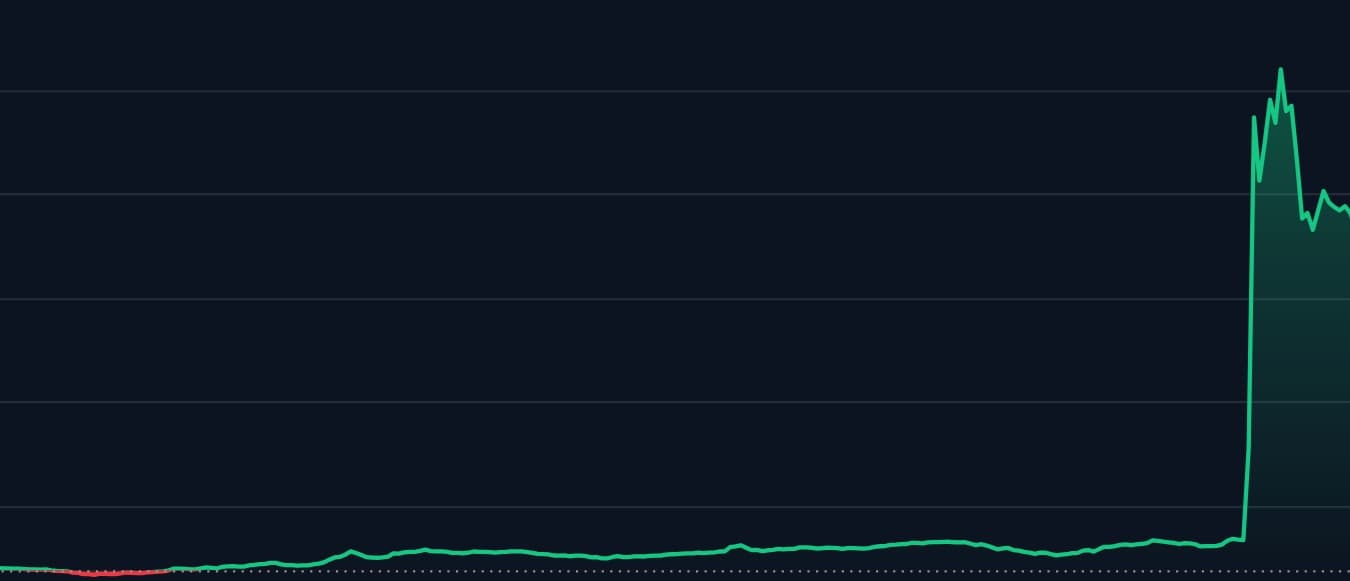
The latest reported burn, for May 20, removed 9,493,217 RSR, after a burn totalling $15,559. The chart shows the cumulative burn curve steepening from late 2025 into early 2026, with most of the total now coming from the past several months.

For CMC20, the minting fee is 0.3%, with one-third going to the RSR burn, effectively making the burn around 0.1% of the minted amount.
CMC20 is the clearest example of a DTF, packaging exposure to the top crypto assets into a single on-chain index token, thereby giving users a simpler way to hold broad market exposure without manually managing a portfolio. CoinMarketCap tracks CMC20 as a live asset, with real-time price data, market cap, and trading volume.
DTFs are on-chain versions of familiar fund structures and while they are not ETFs in the legal sense, the comparison is useful: a DTF bundles assets into a single token, can be minted and redeemed on-chain, and can be governed by token holders. CMC20 is RSR, with RSR holders able to vote-lock tokens to become governors of the DTF.
The current burn total is a proxy for one of Reserve’s most important questions: are people actually using the products? Metrics-wise, from May 2025 to January 2026, the burn grew from almost nothing to around 30 million RSR. By March, it had crossed 60 million. After the May burn, the total sits above 85 million.
The next test is whether Reserve’s DTF catalog can expand beyond crypto-native indexes. That is where the incoming AI-themed equity DTFs become important.
As we reported last month, ABC Labs plans to launch AI-themed equity DTFs this summer, built around tokenized U.S. stocks. The first AI DTF is expected after tokenized AI stocks arrive, with the broader idea being simple: instead of buying individual tokenized equities one by one, users can buy an on-chain index tracking a theme.
If those products attract minting volume, the burn can rise again. AI equities are easier for many investors to understand than niche crypto baskets. Nvidia, Microsoft, AMD, Palantir, or other AI-linked names already have mainstream attention. A tokenized AI stock basket gives Reserve a more familiar story to tell: thematic exposure, on-chain settlement, 24/7 trading, and programmable governance.
Reserve Protocol is a DeFi infrastructure project for creating and governing decentralized token baskets, including stable asset products and index-style DTFs. Its recent focus has shifted heavily toward on-chain indexes: crypto baskets such as CMC20, real-world asset structures, and now planned equity-themed products.
Source: RSR Burn Dashboard

Reserve Protocol DTFs are like ETFs, but on-chain, and tradeable without barriers 24/7. The first AI DTF is expected in June.
AI really is the focus of… basically everyone. But right now, it is hard to invest in the narrative, unless you have a broker to buy specific company shares or can buy specific, ringfenced ETFs in certain countries.
That may all change in the next month or two, with ABC Labs planning to launch a series of AI-themed equity DTFs (Decentralized Token Folios) this summer, built on tokenized US stocks and aimed at non-US, crypto investors who cannot access the same exposure through traditional brokerage channels.
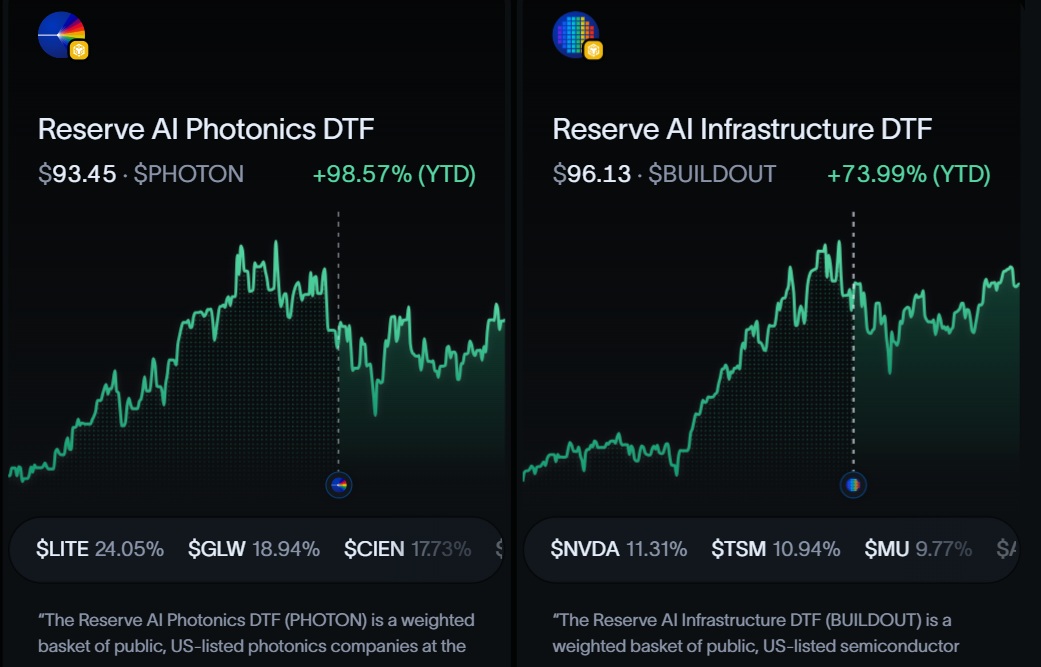
The AI DTFs will focus on different segments (for example, DRAM, photonics, power), and ABC Labs may also offer a wider ‘AI infrastructure DTF’ which captures exposure across the full stack.
DTFs are like ETFs, but on-chain, and tradeable without barriers 24/7. With a range of tokenized AI stocks arriving in June, the first AI DTF is expected a few days after. Instead of buying individual tokenized stocks, buy the index and capture the segment of the industry you are most bullish on.
DTFs can be built and minted using the Reserve Protocol, at https://app.reserve.org.
On the AI front, Reserve cited Situational Awareness, a private, major AI thesis hedge fund, that has $13.6 billion in assets under management.
The recent launch of DRAM is also a recent example, which quickly became a $9 billion ETF.
With ETFs beginning to crop up around the AI industry, it is inevitable their on-chain equivalent - DTFs - will arrive.
But, as Reserve Protocol pointed out on Twitter, “$DRAM is a US-listed ETF, so you can only buy it in countries that are plugged into the US brokerage network. Fund access has progressed from private to public, but still leaves much of the world out.
“We can do better. By creating funds on-chain with tokenized US stocks that are backed 1:1 with underlying equities and accessible outside of the US, we can extend access to most of the globe. That’s what we’re cooking right now, alongside the leading tokenizer of US equities.
“Stay tuned for globally accessible AI supply chain funds in the coming weeks, freely accessible in about 145 countries to about 6 billion people.
“If you are in the trenches on this trade, you can guess which vertical we’ll lead with.”
Our guess on the vertical is photonics, but we will see. Whichever the vertical is, that is likely our first glimpse of the logo up above.
The tokenized US stocks used in the DTFs will be backed 1:1 with underlying equities and may be accessible in as many as 145 countries, with a population of six billion people.
Sources: Telegram, Reserve Forum, Twitter

For May 2026, 9.5M RSR was burned, as noted in the Reserve Telegram channel. The actual burn took place on May 21, 2026.
Every month, a portion of the RSR supply is burned, a product of the fees primarily generated by the minting and holding of Index DTFs.
| Burn Date | RSR burned | USD value |
| May 21, 2026 | 9,493,217 | 17,109.44 |
| Apr 23, 2026 | 14,398,322 | 25,168.27 |
| Mar 23, 2026 | 16,096,854 | 25,223.77 |
| Feb 20, 2026 | 12,674,832 | 19,861.46 |
| Jan 23, 2026 | 3,903,976 | 6,117.53 |
| Dec 21, 2025 | 9,829,776 | 15,403 |
| Dec 1, 2025 | 4,744,733 | 7,435.00 |
| Oct 21, 2025 | 2,975,478 | 4,662.57 |
| Sep 25, 2025 | 1,965,638 | 3,080.16 |
| Aug 22, 2025 | 1,182,789 | 1,853.43 |
| Aug 3, 2025 | 2,734,623 | 4,285.15 |
| Jul 25, 2025 | 527,802 | 827.07 |
| Jun 20, 2025 | 3,746,598 | 5,870.92 |
| May 20, 2025 | 1,281,683 | 2,008.40 |

During the Reserve Q12026 Community Call, Reserve co-founder Nevin Freeman outlined how Reserve is expected to transition to milestone-based RSR unlocks.


For April 2026, 14.4M RSR was burned, as noted in the Reserve Telegram channel. The actual burn took place on April 23, 2026.
Every month, a portion of the RSR supply is burned, a product of the fees primarily generated by the minting and holding of Index DTFs.
Burn Date | RSR burned | USD value |
Apr 23, 2026 | 14,398,322 | 25,168.27 |
Mar 23, 2026 | 16,096,854 | 25,223.77 |
Feb 20, 2026 | 12,674,832 | 19,861.46 |
Jan 23, 2026 | 3,903,976 | 6,117.53 |
Dec 21, 2025 | 9,829,776 | 15,403.26 |
Dec 1, 2025 | 4,744,733 | 7,435 |
Oct 21, 2025 | 2,975,478 | 4,662.57 |
Sep 25, 2025 | 1,965,638 | 3,080.16 |
Aug 22, 2025 | 1,182,789 | 1,853.43 |
Aug 3, 2025 | 2,734,623 | 4,285.15 |
Jul 25, 2025 | 527,802 | 827.07 |
Jun 20, 2025 | 3,746,598 | 5,870.92 |
May 20, 2025 | 1,281,683 | 2,008.40 |

$RSR can now be spent at over 50 million merchants across Southeast Asia, Nigeria, Mexico, Brazil, and Georgia.
$RSR can now be spent at over 50 million merchants across Southeast Asia, Nigeria, Mexico, Brazil, and Georgia. The integration, through a partnership with AEON - a payments infrastructure project building settlement rails for AI-driven commerce - puts RSR into physical retail and online checkout for the first time.
AEON Pay handles the transaction layer, as a mobile payment interface for Web3 assets, accessible through a Telegram Mini App and connected to Bitget Wallet, Binance Wallet, OKX Wallet, TokenPocket, KuCoin, and Bybit. Users do not leave familiar interfaces to pay - a practical detail that tends to determine whether crypto payments actually get used.
RSR's role inside Reserve has historically been narrow in a specific way: stakers provide first-loss capital on Yield DTFs, absorbing losses before other holders if collateral breaks, and in return take a share of yield. Governance rights come with it. But payments are something different, as they give the token a function that does not depend on the protocol's internal mechanics at all.
Reserve's product range is built around Decentralized Token Folios: on-chain instruments that bundle multiple crypto assets into a single token. They behave like index products: transparent composition, immediate redemption, composable with other DeFi protocols.
CMC20, built with CoinMarketCap, tracks the top 20 crypto assets by market cap in a single tradable token. Kraken and Bloomberg have also used Reserve's infrastructure to issue their own DTFs. Until now, these assets have lived almost entirely within DeFi - useful for portfolio exposure, not for buying anything.
If RSR circulates through a payments network, it stops behaving purely as a staking asset or governance token. The underlying structure is still more complex than a stablecoin, but the user experience starts to resemble one. But really, we hope to see DTFs arrive on AEON.
The expansion is targeted at markets where that framing already makes intuitive sense. Nigeria, Mexico, and Brazil are not markets where crypto is mainly a speculative asset - they are places where it functions as a parallel monetary system for people who cannot rely on local currency stability. AEON's further rollout is planned across Africa and Latin America, which sharpens that focus.
The more unusual part of this integration sits in the infrastructure underneath it. AEON Pay is built on x402, a payment protocol released by Coinbase's developer platform in May 2025. The mechanism is a reactivation of HTTP 402, a status code written into the HTTP specification in 1997 under the label "Payment Required."
It was included in the original spec as a placeholder for a future micropayment system that never arrived. Every major browser and server framework has recognized it for nearly three decades; it just never did anything. Coinbase built the protocol to finally use it, connecting HTTP-native payment requests to cheap blockchain settlement.
The reason x402 matters now, specifically, is AI agents. Autonomous software agents are making API calls, consuming data feeds, executing trades, and running multi-step workflows across services - and they need to pay for access to those services without human approval cycles. A credit card form is not a viable option for a process that runs in milliseconds.
x402 allows a server to respond to an agent's request with a payment demand, the agent pays on-chain, and the transaction proceeds - all within the same HTTP interaction.
AEON also supports ERC-8004, an emerging standard for trustless payment channels, and integrates with Google's Agent Payment Protocol, AP2 - a Google-led effort to standardize how AI agents authorize and settle payments.
The practical flow looks something like this: an agent uses Google's A2A protocol to locate a service, AP2 to authorize the transaction, and x402 to settle it. RSR is now a token that can move through that process.
That is a different kind of exposure than merchant payments. Merchant payments are real and immediate - 50 million merchants is a number that means something. But the agent economy is where the volume could get large in ways that are harder to predict, and Reserve now has a position in both.

The SEC’s Division of Trading and Markets has given guidance that offers intel for DeFi users and the creators of DeFi front-ends, such as Reserve Protocol.
The SEC’s Division of Trading and Markets has given guidance that offers some intel for DeFi users and the creators of DeFi front-ends, such as Reserve Protocol's Register. The agency has given a checklist for software developers to avoid the radioactive label of an unregistered broker-dealer.
The guidance isn't law, but does give good intel, as summarized by TheDefiant, and we're going to attempt a layman's interpretation on how it applies to Reserve Protocol.
The Reserve Protocol’s Register app allows for minting and managing Index DTFs, which are similar to on-chain ETFs, as well as Yield DTFs, which are asset-backed currencies supported by diverse collateral baskets.
In our view, compliance hinges partly on the app’s refusal to touch the money. The SEC staff’s primary condition for safety is a total lack of custody, which Register clears by making users bring their own keys and crypto via third-party wallets. If the software never sees a private key and never holds a balance, it escapes the most traditional definition of a broker.
Based on the criteria outlined in the SEC staff guidance and the public documentation for the Reserve Protocol and its interface (Register), here is an evaluation of how the app aligns with those requirements:
Pass: The Reserve Protocol and the Register app are explicitly designed as self-custody solutions. Users connect their own third-party wallets (like MetaMask or Ledger). According to the Reserve Terms and Conditions, the protocol does not have "possession, custody or control" over any user's digital assets.
Pass: The interface is built to facilitate the creation and management of DTFs. While it displays information about different DTFs and their underlying collateral, the documentation classifies this as "informational purposes only." It does not provide personalized advice, nor does it recommend specific trades to users.
Pass: The Register app acts as a front-end for interacting with on-chain smart contracts. When a user mints or redeems DTFs , the "execution" happens via the user's own wallet and the blockchain, not via a centralized matching engine or a proprietary routing service owned by the app operator. The app facilitates "user-initiated" transactions as defined in the guidance.
Pass: The Reserve Protocol utilizes a transparent, code-governed fee structure. DTFs can have specific "Mint Fees" and "Redemption Fees," which are typically set as a fixed percentage (e.g., 0.15% or 0.25%) by the specific DTF’s governance. These fees are programmed into the smart contracts rather than being dynamic "spreads" or hidden markups typical of traditional broker-dealers.
Pass: Transactions on the Register app are atomic and governed by smart contracts. The protocol team does not have the ability to manually pause, reverse, or selectively approve individual user transactions. Rebalancing and collateral auctions are "entirely mechanistic based on on-chain price-feeds" and do not depend on human judgment or manual discretion by the developers.
Labeling Routes as "Best" or "Preferred": To remain compliant with this specific staff guidance, the Register app must ensure it does not label specific DTFs or trading paths with subjective terms like "Best Yield" or "Recommended." Most DeFi interfaces have recently moved toward neutral sorting (e.g., by TVL or alphabetical) to avoid this, and Reserve has historically been careful in this regard.
Commentary: The app must avoid marketing language that could be interpreted as financial promotion or investment advice. Which is basically Nevin's mantra.
Requirement | Status | Evidence |
No Custody | ✅ Pass | Uses self-custodial wallets; no control over user keys. |
No Advice | ✅ Pass | Purely informational interface; no trade recommendations. |
No Routing/Execution | ✅ Pass | Users sign and broadcast their own transactions. |
Fixed % Fees | ✅ Pass | On-chain mint/redeem fees are fixed by protocol parameters. |
No Discretion | ✅ Pass | Mechanistic, smart-contract-driven activity; no human "gatekeeper." |
Conclusion: The Reserve Protocol’s "Register" app appears to align well with the SEC staff guidance for "covered user interfaces."
Its decentralized, non-custodial nature is exactly the type of architecture the guidance seeks to distinguish from traditional broker-dealer activities. We'll point out we are not lawyers, and may have missed nuances or got things wrong.