A New Chapter for eUSD
By Matthew
The Electronic Dollar (eUSD) is entering a new era, with the appointment of a new eUSD Champion.
Reserve News — Unofficial news about Reserve Protocol
Back to all articles

By Matthew
The Electronic Dollar (eUSD) is entering a new era, with the appointment of a new eUSD Champion.
Reserve News — Unofficial news about Reserve Protocol
Back to all articles
By Matthew
The Electronic Dollar (eUSD) is entering a new era, with the appointment of a new eUSD Champion.
Reserve News — Unofficial news about Reserve Protocol
Back to all articles
The SEC’s Division of Trading and Markets has given guidance that offers intel for DeFi users and the creators of DeFi front-ends, such as Reserve Protocol.
The SEC’s Division of Trading and Markets has given guidance that offers some intel for DeFi users and the creators of DeFi front-ends, such as Reserve Protocol's Register. The agency has given a checklist for software developers to avoid the radioactive label of an unregistered broker-dealer.
The guidance isn't law, but does give good intel, as summarized by TheDefiant, and we're going to attempt a layman's interpretation on how it applies to Reserve Protocol.
The Reserve Protocol’s Register app allows for minting and managing Index DTFs, which are similar to on-chain ETFs, as well as Yield DTFs, which are asset-backed currencies supported by diverse collateral baskets.
In our view, compliance hinges partly on the app’s refusal to touch the money. The SEC staff’s primary condition for safety is a total lack of custody, which Register clears by making users bring their own keys and crypto via third-party wallets. If the software never sees a private key and never holds a balance, it escapes the most traditional definition of a broker.
Based on the criteria outlined in the SEC staff guidance and the public documentation for the Reserve Protocol and its interface (Register), here is an evaluation of how the app aligns with those requirements:
Pass: The Reserve Protocol and the Register app are explicitly designed as self-custody solutions. Users connect their own third-party wallets (like MetaMask or Ledger). According to the Reserve Terms and Conditions, the protocol does not have "possession, custody or control" over any user's digital assets.
Pass: The interface is built to facilitate the creation and management of DTFs. While it displays information about different DTFs and their underlying collateral, the documentation classifies this as "informational purposes only." It does not provide personalized advice, nor does it recommend specific trades to users.
Pass: The Register app acts as a front-end for interacting with on-chain smart contracts. When a user mints or redeems DTFs , the "execution" happens via the user's own wallet and the blockchain, not via a centralized matching engine or a proprietary routing service owned by the app operator. The app facilitates "user-initiated" transactions as defined in the guidance.
Pass: The Reserve Protocol utilizes a transparent, code-governed fee structure. DTFs can have specific "Mint Fees" and "Redemption Fees," which are typically set as a fixed percentage (e.g., 0.15% or 0.25%) by the specific DTF’s governance. These fees are programmed into the smart contracts rather than being dynamic "spreads" or hidden markups typical of traditional broker-dealers.
Pass: Transactions on the Register app are atomic and governed by smart contracts. The protocol team does not have the ability to manually pause, reverse, or selectively approve individual user transactions. Rebalancing and collateral auctions are "entirely mechanistic based on on-chain price-feeds" and do not depend on human judgment or manual discretion by the developers.
Labeling Routes as "Best" or "Preferred": To remain compliant with this specific staff guidance, the Register app must ensure it does not label specific DTFs or trading paths with subjective terms like "Best Yield" or "Recommended." Most DeFi interfaces have recently moved toward neutral sorting (e.g., by TVL or alphabetical) to avoid this, and Reserve has historically been careful in this regard.
Commentary: The app must avoid marketing language that could be interpreted as financial promotion or investment advice. Which is basically Nevin's mantra.
Requirement | Status | Evidence |
No Custody | ✅ Pass | Uses self-custodial wallets; no control over user keys. |
No Advice | ✅ Pass | Purely informational interface; no trade recommendations. |
No Routing/Execution | ✅ Pass | Users sign and broadcast their own transactions. |
Fixed % Fees | ✅ Pass | On-chain mint/redeem fees are fixed by protocol parameters. |
No Discretion | ✅ Pass | Mechanistic, smart-contract-driven activity; no human "gatekeeper." |
Conclusion: The Reserve Protocol’s "Register" app appears to align well with the SEC staff guidance for "covered user interfaces."
Its decentralized, non-custodial nature is exactly the type of architecture the guidance seeks to distinguish from traditional broker-dealer activities. We'll point out we are not lawyers, and may have missed nuances or got things wrong.

ABC Labs and Confusion Capital have delegated 60% of their staked RSR voting power across four live Yield DTFs: eUSD, ETH+, bsdETH, and USD3.
Reserve Protocol now has its first group of Guardians, with six delegates now in place, and the majority of core voting power has been pushed out of the founding entities and into their hands.
ABC Labs and Confusion Capital have delegated 60% of their staked RSR voting power across four live Yield DTFs: eUSD, ETH+, bsdETH, and USD3. The move reduces direct control from the core collaborators and places it with a group of independent but accountable participants.
The program began on April 1 and will run for three months through June 30 as an initial test.
The delegates are already assigned, and each one covers two Yield DTFs (formerly RTokens), with three delegates watching every DTF. That overlap creates redundancy where governance has historically been thin. If one delegate misses something, the other two are still in the room.
The names are known participants - 0xd15co, Braden, Eureka, Ham, R72, and Zeb - now operating with a defined scope and visible responsibility. Their job is straightforward: read proposals, vote, and explain themselves in public.
That last requirement is non-negotiable: every vote must include a written rationale posted in the delegate’s forum thread.
Participation is tracked, with a 90% voting coverage target across all proposals. Miss it once, and the system flags it. Miss it twice, and they’re out. The role is voluntary and not permanent, but participation is required.
Delegates receive $250 per month in RSR, which is enough to formalize the role, but not enough to compete over. The expectation is that these are already engaged participants, not applicants chasing yield.
On eUSD, roughly 239.6 million stRSR has been distributed across delegates. ETH+ accounts for another 47.5 million. USD3 and bsdETH follow with smaller allocations. Across each product, a measurable share of governance has been moved out of the hands of its largest stakeholders.
In effect, delegates now sit between passive stakers and live governance in a layer that did not exist before. Previously, proposals often relied on a mix of core contributors and sporadic community attention. Now, specific people are expected to show up every time.
The system is still open, with no hard barrier to becoming a delegate and no restriction on who can receive delegated voting power. The six names announced this week are the starting point, and others can enter if they can attract a delegation and maintain the same level of participation.
Read more: Reserve Forums

Security firm Trail of Bits has singled out Reserve Protocol as an example of how DeFi code should be written.

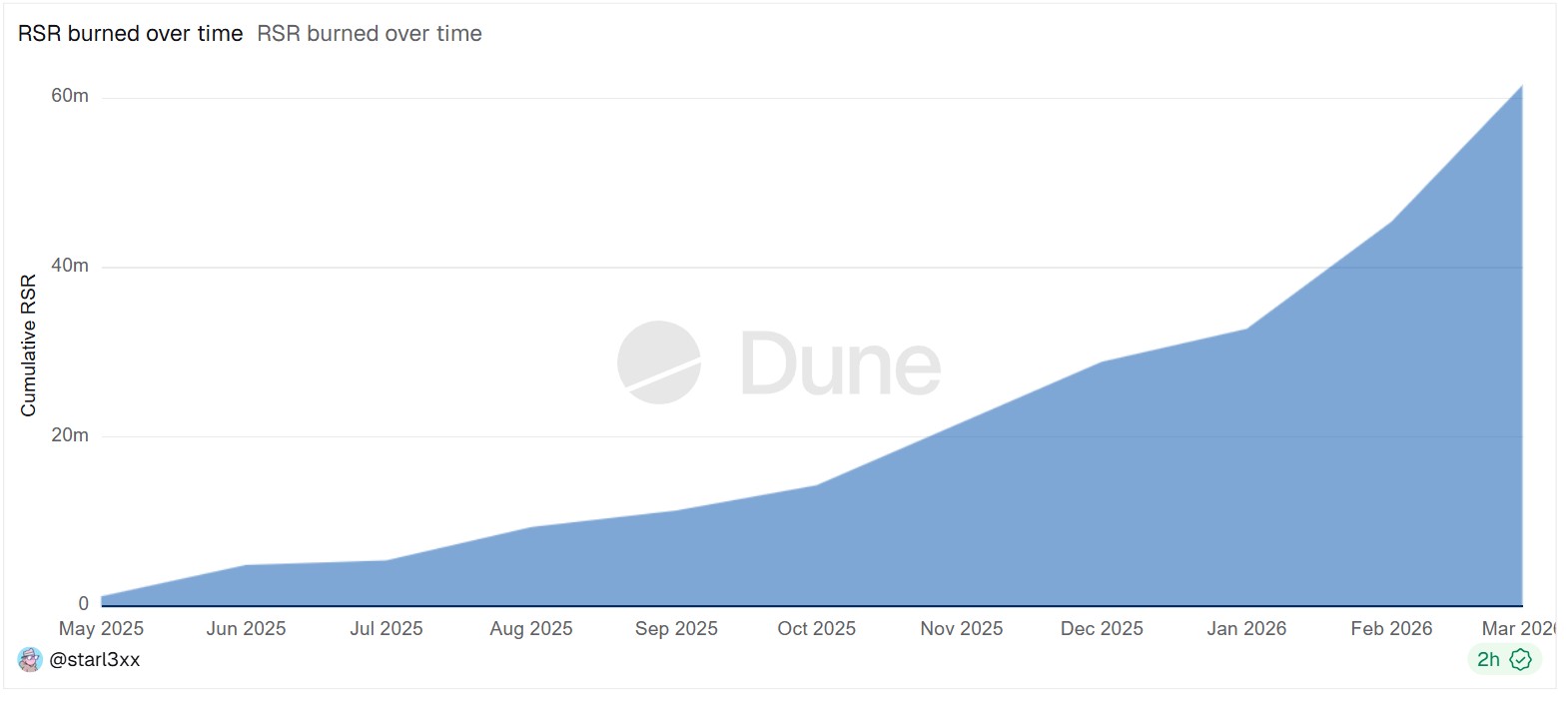
As of March 2026, 61.6 million RSR has been burned by Reserve Protocol so far.
How much RSRs burn each month?
As a dollar amount: $96,629

|
Date |
RSR burned |
USD value |
|
Mar 23, 2026 |
16,096,854 |
25,223.77 |
|
Feb 20, 2026 |
12,674,832 |
19,861.46 |
|
Jan 23, 2026 |
3,903,976 |
6,117.53 |
|
Dec 21, 2025 |
9,829,776 |
15,403.26 |
|
Dec 1, 2025 |
4,744,733 |
7,435 |
|
Oct 21, 2025 |
2,975,478 |
4,662.57 |
|
Sep 25, 2025 |
1,965,638 |
3,080.16 |
|
Aug 22, 2025 |
1,182,789 |
1,853.43 |
|
Aug 3, 2025 |
2,734,623 |
4,285.15 |
|
Jul 25, 2025 |
527,802 |
827.07 |
|
Jun 20, 2025 |
3,746,598 |
5,870.92 |
|
May 20, 2025 |
1,281,683 |
2,008.40 |
As a TLDR, the burn rate scales with TVL, not speculation. A larger index base (more capital sitting inside CMC20, BTC-focused baskets, or thematic portfolios) translates into a higher dollar value of fees, which in turn translates into more RSR being bought and burned.
The mechanics sit inside a broader design choice: Reserve Protocol is trying to tie token economics to real protocol revenue. The RSR token serves as collateral and governance for the Reserve Protocol, and its role inside decentralized token folios has expanded alongside the protocol’s evolution.
What began as a stability-first system now leans into index products and yield-bearing RToken structures, with fees flowing back into the reserve ecosystem in a way that directly affects circulating supply.
Once a month, the revenue from each Index DTF is gathered, and then used to buy and burn RSR. The assets collected, whether from management fees or minting, are routed through an decentralized exchange, converted into the Reserve Rights token, and sent to a burn address.
That process reduces the total supply over time, creating deflationary pressure tied to usage. It’s not a fixed schedule, and the revenue generated depends on adoption, TVL, and how much capital flows through each chain where these products are deployed.
For RSR holders, the model is designed to align long term holders with the protocol’s success. As more capital enters Decentralized Token Folios, the fee base grows. That increases buy pressure on the RSR token while removing units from circulation, a dynamic that aims to offset sell pressure during weaker periods.
The idea is simple enough: more usage leads to more token burn, which in turn can increase scarcity and influence long term value, even if short-term price impact remains uneven.
Governance is part of that mechanism, with RSR stakers influencing risk parameters, vote on governance proposals, and shape how fees are structured or distributed. Governance weight is tied to stake, which means those committing capital have a direct role in maintaining stability and setting insurance buffers across the system.
This governance model has already been tested through changes to fee splits, collateral baskets, and the handling of protocol revenue.
There’s also an growing conversation around a more explicit burn proposal. While the current system already reduces supply through fee-driven buybacks, some members of the community have discussed whether a larger portion of revenue should be directed toward increasing token scarcity more aggressively in a new governance model, potentially prioritizing burn over other uses like incentives or insurance buffers.
For now, the balance remains dynamic, with governance proposals adjusting how revenue is allocated as the protocol moves forward.
If adoption of the products grows, particularly those generating yield through integrations with platforms like Curve Finance, the portion of revenue feeding into buybacks increases. Over time, that can reduce circulating supply in a way that reflects real economic activity rather than artificial constraints.
For discerning investors, it is less about immediate profit and more about whether the system can maintain demand. The main goal is to create a situation where usage drives revenue, revenue drives burns, and burns reinforce scarcity.
If that holds, it strengthens the project’s future. If it breaks (if adoption stalls or yield dries up) the burn mechanism becomes less relevant.
It is a structure that aims to connect governance, revenue, and supply in a way that rewards participation and allows holders to earn rewards through staking and influence. This is not financial advice and whether it succeeds depends on the community, the pace of adoption, and how effectively RSR holders continue implementing changes that keep the system competitive.
Call it an introduction to a different kind of token model: one where scarcity is earned, not declared, and where every burn is the result of activity on-chain rather than a line in a whitepaper.
If you want to track the burn yourself, there is a Dune dashboard by Starl3xx

For February 2026, around ~16.M RSR will be burned, as noted in the Reserve Telegram channel. The actual burn takes place on March 23, 2026.
Every month, a portion of the RSR supply is burned, a product of the fees primarily generated by the minting and holding of Index DTFs.

The program is designed to formalize and incentivize active participation in governance of on-chain indexes on Reserve Protocol.
Applications for the Reserve Protocol’s new delegate program are set to close on Wednesday, 18 March at midnight UTC, marking the final opportunity for participants to get paid to help govern DTFs (on-chain indexes and sta
ble currencies) on Reserve.
The program, as outlined in a recent governance proposal on the Reserve forum, is designed to formalize and incentivize active participation in governance. At its core is a simple idea: pay contributors to pay attention.
Selected delegates will receive $250 per month to review proposals, vote on governance decisions, and represent the interests of the broader community. The structure is intentionally lightweight and not a full-time role, but rewards those already following the protocol closely and can make wise, articulated decisions across the ecosystem.
Visibility and accountable participation are the important aspects. Those applying are effectively being paid to be in an environment where reputation, consistency, and clarity of thinking matter.
Many protocols have struggled with governance apathy where token holders fail to vote, proposals pass with minimal scrutiny, and decision-making concentrates in a small number of active participants. While Reserve in time may move to optimistic governance, maintaining DTFs needs close, careful work.
The delegate model attempts to fix that by introducing named actors with defined responsibilities where, instead of anonymous wallets, governance becomes something closer to a public process. Delegates are expected to:
review proposals in detail
engage in forum discussions
vote with clear reasoning
build a track record over time
The monthly stipend is not large, but that is part of the design. It is enough to create accountability without turning the role into a purely financial incentive.
Reserve Protocol is entering a period of increased activity across its ecosystem, with:
new DTF launches
changes to eUSD revenue share structures
potential integrations with tokenized assets
ongoing governance around product design
As the number of proposals grows, so does the need for informed participants who can process them quickly and publicly.
Once applications close, the next phase will likely involve:
selection or recognition of initial delegates
early governance participation
tracking of engagement and performance
From there, the system can evolve, and delegate influence may grow as token holders choose to follow and delegate voting power to those they trust.
In that sense, the program is less about the initial $250 monthly payment and more about establishing an accountable, decentralized layer of governance inside Reserve.
For anyone already following Reserve Protocol and who wants to take part, a reminder that applications close Wednesday, 18 March at midnight UTC (we expect this may be extended, but let's see).
Apply to be a Reserve Delegate

Uglycash-linked wallets have increased their holdings of eUSD by roughly $864,000 over the past month, according to data from the latest snapshot.

Reserve co-founder Nevin Freeman has outlined how the newly released version of the Uglycash app now features Reserve DTFs (on-chain indexes) prominently.
In a packed update, Reserve co-founder Nevin Freeman has outlined how the newly released version of the Uglycash app now features Reserve DTFs prominently, alongside tokenized equities and other crypto assets.
“UGLYCASH is our retail-facing app, designed to bring DTFs to a broader audience through a social trading experience rather than requiring users to interact with the protocol directly,” Freeman wrote.
Rather than searching through token lists or DeFi dashboards, users can discover assets through traders and communities they follow. Within the app, users can buy DTFs like CMC20, track portfolios, and interact with multiple chains from a single balance.
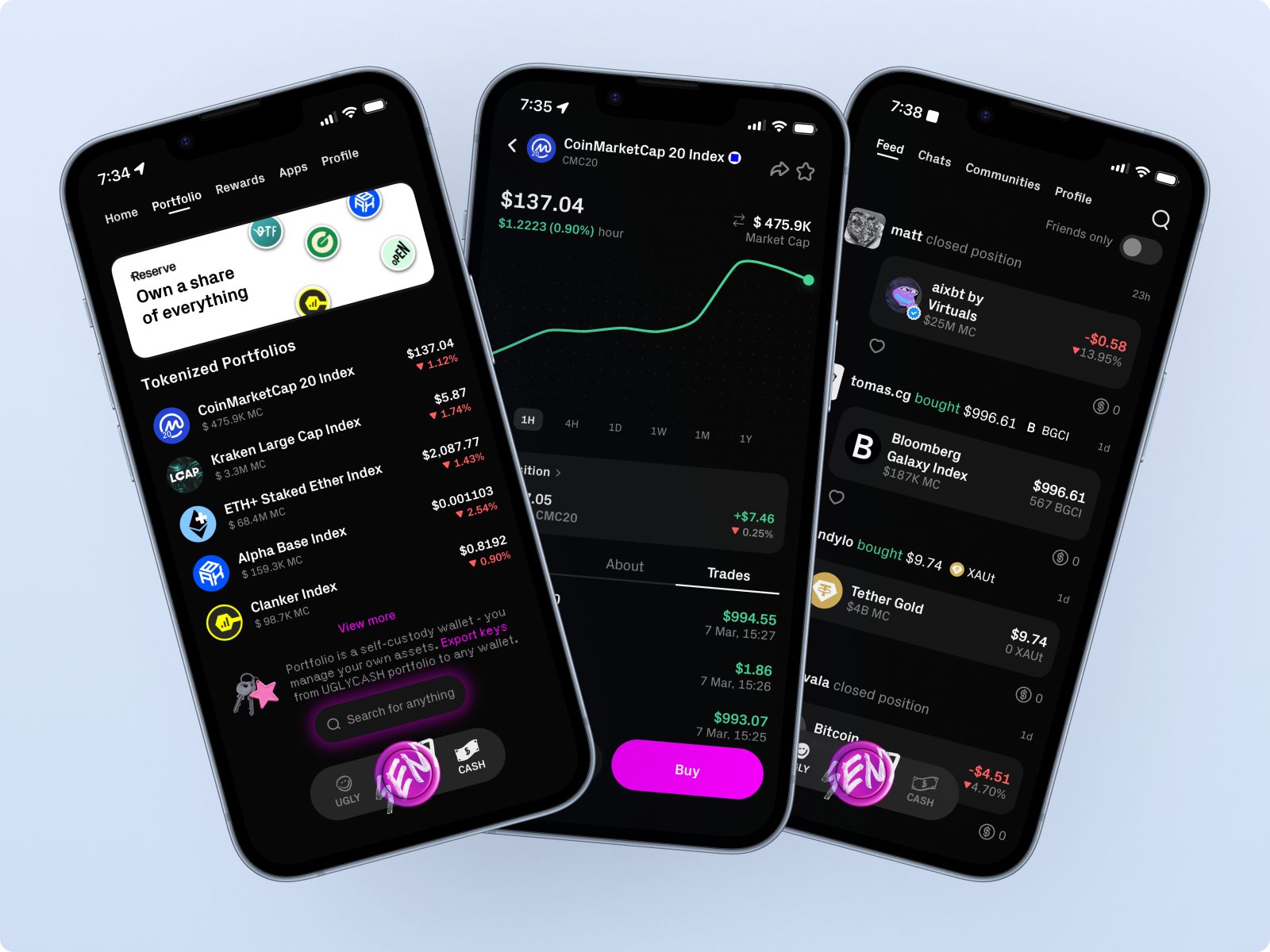
For users outside the United States, the experience goes further, as the new version also integrates tokenized stocks and ETFs through Ondo’s tokenized asset infrastructure, allowing equities to sit alongside crypto portfolios in the same interface. Availability varies by region, but it does make wallet a hybrid financial dashboard.
Early promotional campaigns inside the app include a trader leaderboard and social engagement rewards, intended to encourage discovery through the platform’s social layer rather than traditional asset search.
Alongside the Uglycash revamp, the Reserve team introduced three new experimental DTFs to members of its “Top 100” testing group.
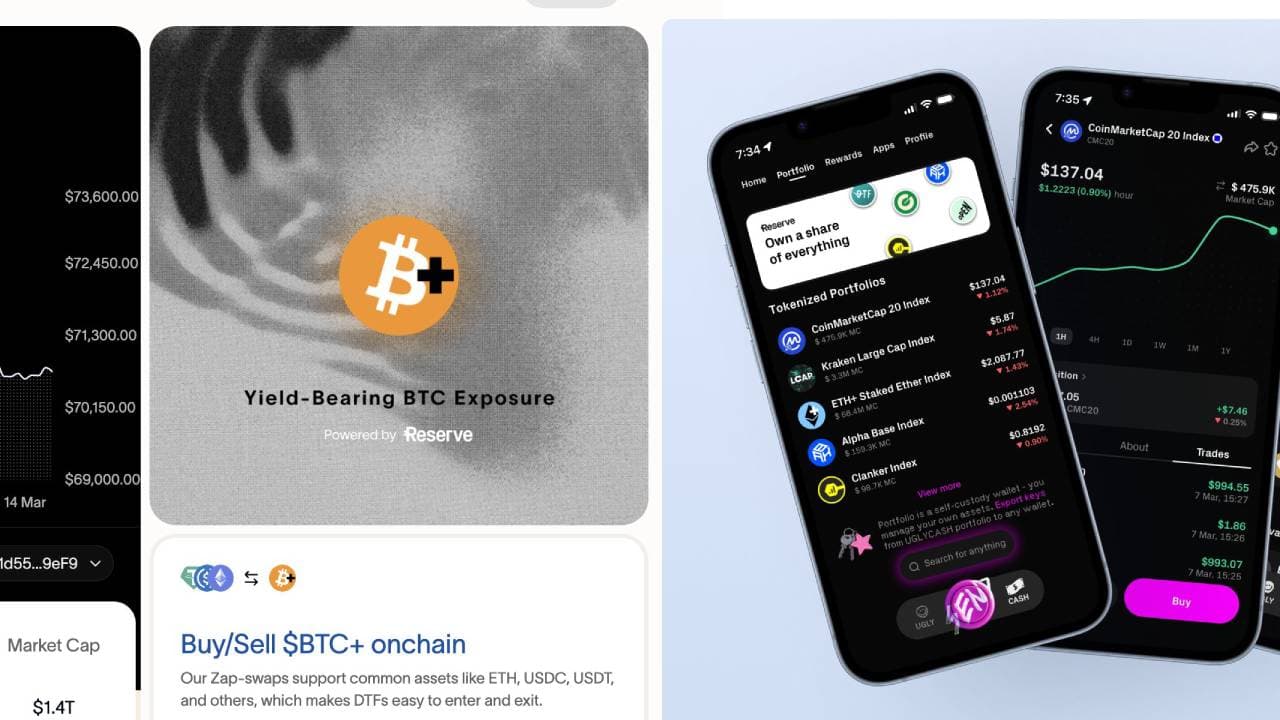
The most notable is BTC+, an index of yield-bearing Bitcoin positions packaged as a decentralized token folio. The basket currently includes liquidity pool positions across several Bitcoin wrappers, wBTC, cbBTC, and tBTC, with yield generated through trading fees.
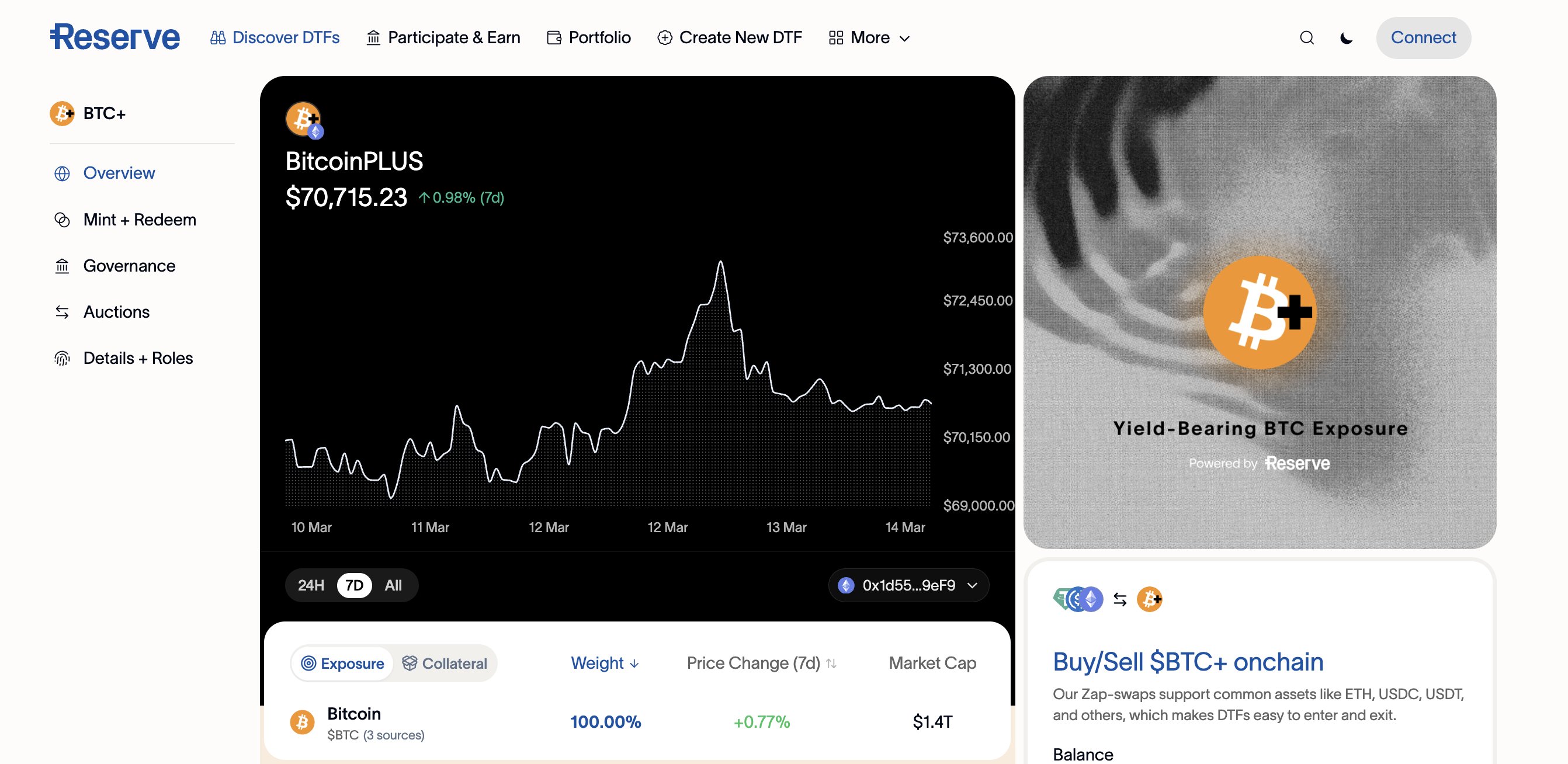
Combined with a mechanism that redirects part of the mint fee to existing holders, the strategy is currently producing roughly 2.5% to 3.5% APY.
Two additional products were introduced during the same weekly sync.
MCAP packages Bitcoin and Ethereum exposure into a single token using a hybrid weighting approach, blending market capitalization and equal weighting.
Harvest, by contrast, is a volatility strategy with a portfolio that holds ETH and a yield-bearing stablecoin and rebalances whenever ETH moves by roughly ten percent, systematically buying dips and locking in gains.
Backtesting suggested the Harvest strategy could outperform pure ETH exposure while reducing volatility across multiple market regimes. For now, all three products remain limited to the Top 100 audience while the team observes real-world behavior.
Reserve’s stablecoin ecosystem is also undergoing changes. A community effort is underway to formalize the mandate and methodology for eUSD, the protocol’s dollar-denominated RToken used widely in fintech integrations. Governance delegate Ham is drafting a detailed framework covering basket composition, engineering requirements, and revenue mechanics.
Part of that work involves clarifying how revenue flows through the ecosystem. Under the current structure, staked RSR receives 100% of revenue generated on eUSD balances held outside fintech wallets. In future, this may increase to include 10% of revenue generated on fintech-held balances.
The goal of the new documentation is to make those economics explicit and easier to understand for both developers and governance participants.
Freeman described the process as part of a broader effort to bring greater transparency and structure to how Reserve’s financial products evolve.
Reserve’s Digital Securities Initiative (DSI) continues to explore how traditional securities might eventually move onchain.
The initiative, working alongside the Tokenized Asset Coalition, recently submitted a proposal to the U.S. Securities and Exchange Commission’s crypto task force outlining a framework known as the Global Access Protocol. The proposal argues for regulatory clarity that would allow tokenized securities to operate on blockchain infrastructure while still meeting compliance requirements.
Research work continues behind the scenes. According to Freeman, the DSI team has been studying multiple legal and technical models for securities tokenization, examining questions around transfer agents, shareholder registries, and proxy voting.
The effort remains exploratory, but the research is becoming increasingly detailed as the team prepares for eventual pilot programs.
Freeman’s update also included a range of additional technical and product work underway across the Reserve ecosystem.
• The Reserve app portfolio page has been redesigned to show DTF holdings, staked RSR, governance proposals, and voting power in a single interface.
• An RFC proposes formally deprecating 17 dormant DTFs, allowing the ecosystem to focus attention on actively maintained products.
• The internal backtesting system gained a new Signals interface for designing custom weighting strategies.
• Research teams are experimenting with adaptive Bitcoin trading models such as Cycle-Aware moving averages and the Kaufman Adaptive Moving Average.
• Engineers are exploring how to integrate real-world assets with delayed settlement into DTF structures.
• The team is building purpose-built AI research tools after abandoning a generic agent framework that proved unsuitable for strategy development.
Freeman framed the work as part of a long-term effort to build the infrastructure for on-chain index products.
“Decentralized governance requires attention,” he wrote when discussing the deprecation of dormant DTFs. “We want to point people toward the products that are most likely to get sustained attention from their communities and curators.”
The full update runs much longer on the X thread, where the discussion continues.